

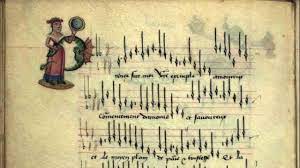
The medieval music theorist Guido d’Arezzo developed the four-line music staff—the precursor to the five-line staff—in or around the year 1024. Western art music notation as we know it today would not exist were it not for this revolutionary change. This February, the Daily Classical Music Post will explore music using interesting, unusual, and innovative music notation.
Ockeghem: Prenez sur moi vostre exemple amoureux
The Franco-Flemish composer Johannes Ockeghem was an innovator and perhaps one of the most influential composers of the early Renaissance in Europe. Very little of his oeuvre is extant, but what we do have shows an incredibly inventive and exciting musician. Some of the works that we do know about have since been considered to be by other composers, but the ones that are definitely by him are the most interesting technically.
Ockeghem’s chanson “Prenez sur moi vostre exemple amoureux,” for three voices, is a terrific example of his use of alternative notations. This chanson was ostensibly written in “Fa-clef,” as opposed to “Do-clef.” “Fa-clef” tells the musicians where “Fa” is, whereas “Do-clef” tells them where “Do” is. Placement of the clef completely changes the sound of a piece.
But sometimes it isn’t even clear which clef the work was written in! Peter Woetmann Christoffersen said, “David Fallows did put his finger on a crucial question, when he concerning the notation of ‘Prenez sur moi’ asked ‘Why are the pieces written without clefs?’ . . . I cannot fill that gap except in offering two observations. The first is that the notion of a puzzle or game was plainly intriguing to many composers, particularly if it involved the kind of economy resolved by simple logic that we find here. The second observation is that composers have always derived inspiration from challenges erected by their predecessors; then as now, they show an awareness of the tradition within which they write. . . . The whole idea of a repertory of pieces sounding at indeterminate pitch—how small this repertory may be—is of great importance for the discussion of pitch in the 15th century.”
Ockeghem used the confusion about clefs to introduce a new idea about diatonic canon and imitation. He used a wide range of flats and sharps throughout the single written voice part. His expertise in the theory behind the use of Fa-clefs confused musicians and music theorists for centuries, and there is still a great deal of debate about exactly what his intentions were when composing this chanson.
My classical music post for today is Johannes Ockeghem’s “Prenez sur moi vostre exemple amoureux.”


Leave a Reply