

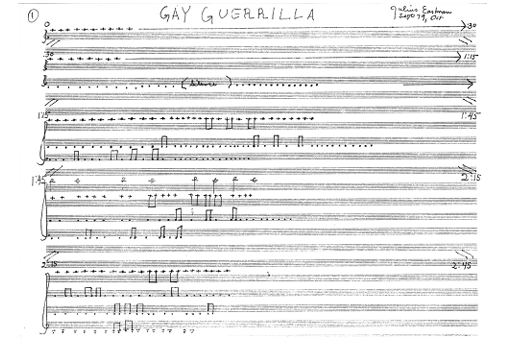
The medieval music theorist Guido d’Arezzo developed the four-line music staff—the precursor to the five-line staff—in or around the year 1024. Western art music notation as we know it today would not exist were it not for this revolutionary change. This February, the Daily Classical Music Post will explore music using interesting, unusual, and innovative music notation.
Regular readers of the DCMP will know that I am a big fan of the American composer and singer Julius Eastman (1940–1990). Much of Eastman’s music explores both his Black and his gay identity. He increasingly felt that he was not given the opportunities that he should have been given, and he turned to alcohol and drugs. He died homeless, broken, and alone, and his death was not even remarked upon until eight months after he died.
John Smigielski said, “Gay Guerrilla (1979) stands as Julius Eastman’s most powerful tribute to the fight for gay rights. He spoke of the word ‘guerrilla’ glorifying the word ‘gay.’ As to why he used the word guerrilla, he said: ‘a guerrilla is someone who is in any case sacrificing his life for a point of view and you know if there is a cause, and if it is a great cause those who belong to the cause will sacrifice their blood, because without blood there is no cause. So therefore that is the reason I use “gay guerrilla” in hopes that I might be one of them, if called upon’.”
Gay Guerrilla, composed for four pianos, is a great example of Eastman’s “organix” music. He explained this type of music in an interview: “[T]he third part of any part has to contain all the information of the first two parts, and then go on from there. Therefore, unlike Romantic music and Classical music in which you have contrasting sections, these pieces’ sections contain all the information of previous sections, or else the information is taken out at a gradual and logical rate.”
Gay Guerrilla is a sort of chorale fantasia, and Eastman uses “A Mighty Fortress Is Our God,” as Smigielski said, “as a call to rise up and overcome oppression. The melody emerges out of the midst of chaos and becomes the climax of the piece.” The score is organised and improvisatory all at the same time. The small cells of notes that you can see in the score are really a jumping-off point for the performers.
My classical music post for today is Julius Eastman’s Gay Guerrilla.


Leave a Reply