

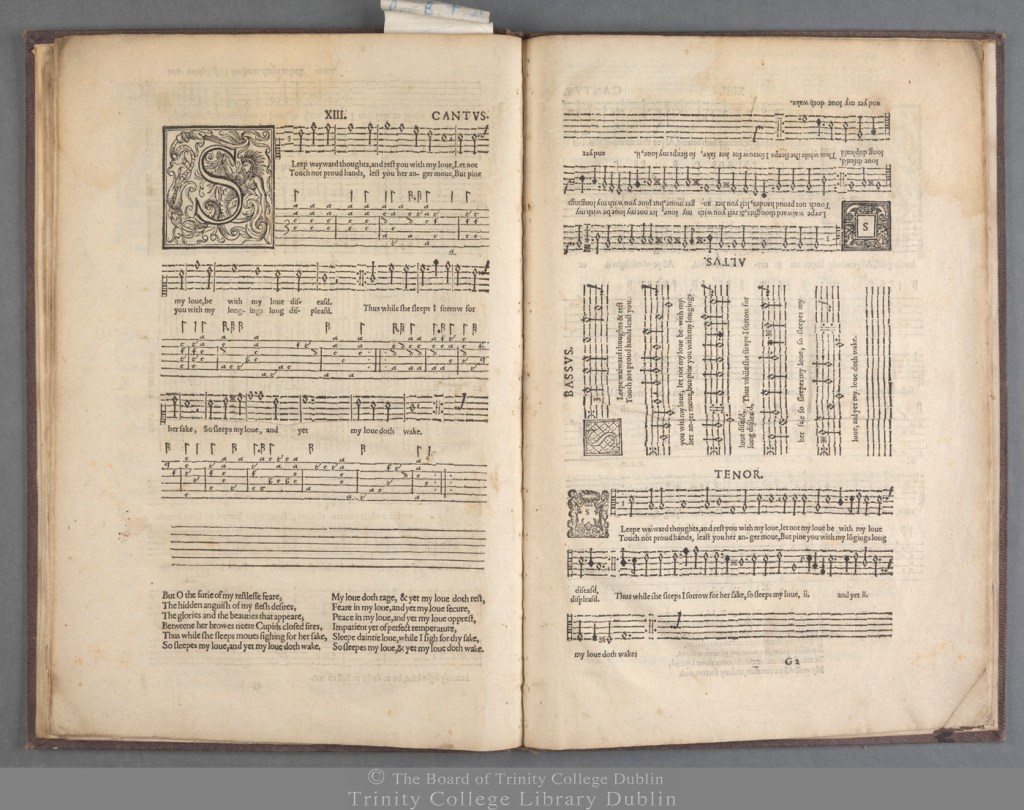
The medieval music theorist Guido d’Arezzo developed the four-line music staff—the precursor to the five-line staff—in or around the year 1024. Western art music notation as we know it today would not exist were it not for this revolutionary change. This February, the Daily Classical Music Post will explore music using interesting, unusual, and innovative music notation.
Dowland – Sleep Wayward Thoughts
The English composer John Dowland (1563–1626) was born a Protestant, but he apparently converted to Catholicism when he was 17 and went to France as a “servant” to the ambassador to the King of France. As he never made a big deal out of his conversion, this didn’t stop him becoming favored by a member of Elizabeth I’s court. Although he did spend several years in the employ of the King of Denmark, he was not subject to the penalties with which many recusants (those who remained loyal to the Roman Catholic Church and did not support the Church of England) had to deal.
Dowland was a lutenist, so many of his songs were composed for voice and lute. He also composed works for viol consort and lute, and his Lachrimae, or Seaven Tears is one of the most famous works of the English Renaissance. His First Booke of Songes or Ayres, published in 1597, is considered to be one of the most influential collections for lute in music history.
Roy Stanley said, “John Dowland’s ‘First booke of songes or ayres’ . . . has particular significance because of its innovative typographical design. Each song can be performed by a solo voice with lute accompaniment (printed on the left-hand page), but is also set for four voices, with the three lower voice parts printed on the right-hand page in a layout designed to allow the singers to read from a single copy while seated around a table (hence the term ‘table-book’ to describe this format).” This format turned out to be extremely popular, and other composers used it in their publications, particularly for glees and madrigals.
My classical music post for today is John Dowland’s “Sleep, Wayward Thoughts.”


Leave a Reply