

The medieval music theorist Guido d’Arezzo developed the four-line music staff—the precursor to the five-line staff—in or around the year 1024. Western art music notation as we know it today would not exist were it not for this revolutionary change. This February, the Daily Classical Music Post will explore music using interesting, unusual, and innovative music notation.
So far this month, we have been looking at different Western art music notation. Something that I find really fascinating, however, is how non-Western art music notation has in some cases been supplanted by Western notation.
One really good example of this is Japanese shakuhachi musical notation, which is a traditional tablature style of transcribing music. This semi-oral way of writing down what is basically playing instructions that can vary does not give any indication of rhythm or beat, and multiple fingerings for this bamboo flute are implicit in the written characters.
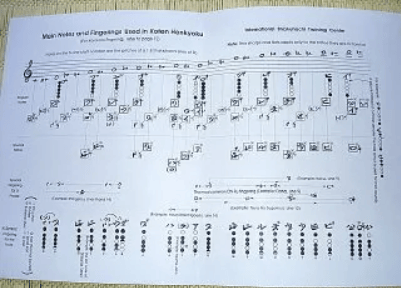
There are publications that still use shakuhachi notation, but when classical music composers include the shakuhachi in their compositions, they use Western notation, often following the chart shown in today’s illustration. This ensures that non-shakuhachi musicians, for example conductors, can tell what is going on!
The Japanese composer Nagasawa Katsutoshi (1923–2008) composed works for traditional Japanese instruments, sometimes transcribing the parts for traditional Western instruments. His musical notation language often was completely Western. Hōshun (Birth of Spring), composed in 1971, was written for shakuhachi and koto (a zither-like instrument), but it has been performed throughout the world with a piano instead of a koto. Mairéid Sullivan said about Hōshun that it is “[a]n evocation of spring and new life. A beautiful interplay of koto and shakuhachi, depicting the new growth and sounds of nature at the beginning of Spring.”
My classical music post for today is Nagasawa Katsutoshi’s Hōshun.


Leave a Reply