

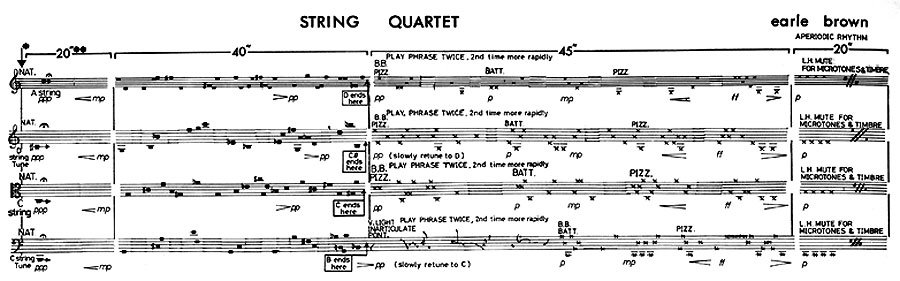
The medieval music theorist Guido d’Arezzo developed the four-line music staff—the precursor to the five-line staff—in or around the year 1024. Western art music notation as we know it today would not exist were it not for this revolutionary change. This February, the Daily Classical Music Post will explore music using interesting, unusual, and innovative music notation.
Earle Brown – String Quartet (1965) [Score-Video]
The American composer Earle Brown (1926–2002) created his own music notational systems. His style of composition influenced many young composers, including John Zorn and many others in New York in the 1980s. Brown was always interested in all of the arts, including the writings of James Joyce and Gertrude Stein, and the works of Abstract Expressionist painters. He said in 2000 that “the earliest and still predominant influences on my conceptual attitude toward art were the works of Alexander Calder and Jackson Pollock . . . the integral but unpredictable ‘floating’ variations of a mobile, and the contextual ‘rightness’ of the results of Pollock’s directness and spontaneity in relation to the materials and his particular image of the work . . . as a total space (of time).”
In 1965, Brown was commissioned to write a string quartet. He said in his program notes to this work: “String Quartet is one of several works in which I have attempted to combine the ‘graphic’ and ‘mobile.’ . . . In composing these later works, which use more than one performer without conductor, I have fixed the overall form but have left areas of flexibility within the inner structures. The works achieve a strong formal identity while maintaining the ‘performer process’ spontaneity and the balance of collaboration between the composition and the performers that are characteristic of the . . . ‘open-form’ and graphic works.”
My classical music post for today is Earle Brown’s String Quartet.


Leave a Reply