

The medieval music theorist Guido d’Arezzo developed the four-line music staff—the precursor to the five-line staff—in or around the year 1024. Western art music notation as we know it today would not exist were it not for this revolutionary change. This February, the Daily Classical Music Post will explore music using interesting, unusual, and innovative music notation.
The German composer Ernst Toch (1887–1964) wrote many symphonies, concertos, piano works, chamber works, and film scores, but I have to say that my very favourite piece of his is the “Fuge aus der Geographie” (Geographical Fugue). He always thought of this piece as an “unimportant diversion,” but it is so much fun to perform! I’ve performed it several times, and every time it is slightly different—it’s no surprise that the English translation was organised by none other than John Cage. It is said that Cage knocked on Toch’s door shortly after Toch emigrated to the United States in the early 1930s. Cage apparently said, “Are you Ernst Toch, the composer of ‘The Geographical Fugue’?” Cage thought it was one of the greatest works ever written.
Toch was the inventor of “Gesprochene Musik,” that is, spoken chorus music. He wrote a three-movement suite, Gesprochene Musik, in 1930, and the premiere caused an absolute sensation. The third movement of this work is the “Fuge aus der Geographie.” The first part is called “O-a,” the second part is called “Ta-Tam”; both of these sections use only nonsense syllables. The “Fuge aus der Geographie” is, as you would imagine, a fugue on various place names (the English translation is given here):
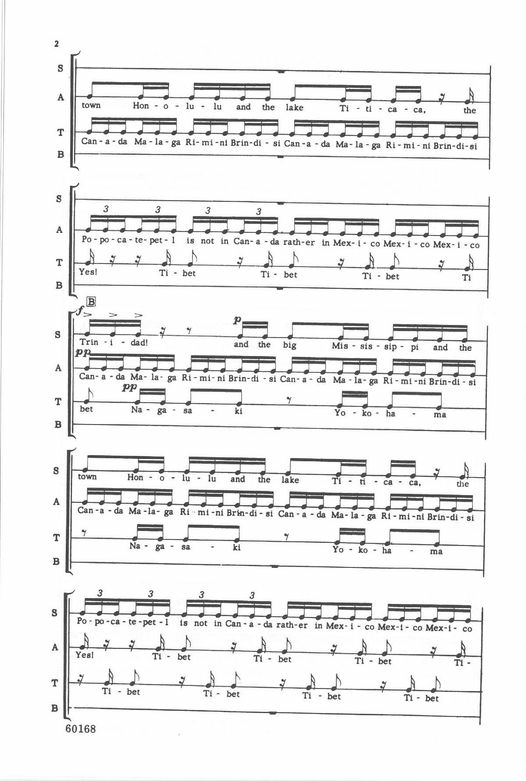
Trinidad! And the big Mississippi and the town Honolulu and the lake Titicaca, the Popocatepetl is not in Canada, rather in Mexico, Mexico, Mexico! Canada, Málaga, Rimini, Brindisi, Canada, Málaga, Rimini, Brindisi, Yes, Tibet, Tibet, Tibet, Tibet, Nagasaki! Yokohama! Nagasaki! Yokohama!
The score for the “Fuge aus der Geographie” looks at first glance like a choral score, but then you realise that all of the parts are written on one note, and that note is just representing the rhythm, not the pitch. Toch didn’t use crosses or other non-notehead notation, as Arnold Schoenberg did in his sprechstimme compositions, but the use of just one staff line and a repeating note gets the point across anyway.
My classical music post for today is Ernst Toch’s “Fuge aus der Geographie.”


Leave a Reply