

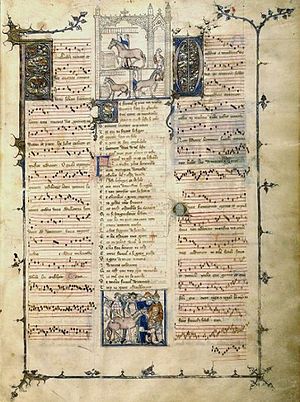
The medieval music theorist Guido d’Arezzo developed the four-line music staff—the precursor to the five-line staff—in or around the year 1024. Western art music notation as we know it today would not exist were it not for this revolutionary change. This February, the Daily Classical Music Post will explore music using interesting, unusual, and innovative music notation.
Vos quid admiramini, virgines – Gratissima virginis species – Gaude gloriosa (Motette)
The French composer, music theorist, and composer Philippe de Vitry (1291–1361) wrote the Ars nova notandi, a 14th-century treatise that lent its name to the music of the entire era. He was considered by his contemporaries to be the greatest musician of his day; no less a figure than Petrarch called him “the keenest and most ardent seeker of truth, so great a philosopher of our age.”
Music of the Ars nova period differed substantially from the music of the preceding era, Ars antiqua. As a result of changes and developments in notation, notes could be written with greater independence of rhythm; secular music became much more sophisticated polyphonically, as sacred music had been previously; and the new isorhythmic motet (in which a single rhythmic figure is continually repeated by a voice) became popular. Time signatures were introduced as well as distinct note values. One of the more controversial innovations was the mixing of secular and sacred music in one composition. This was seen as offensive to Roman Catholic Church officials, but eventually this attitude changed, and before long Renaissance composers were taking secular songs and using them as the basis for masses, motets, and other liturgical music.
Vitry is credited with many of these changes, most particularly the development of isorhythmic composition. In Vitry’s music, the tenor voice, which had been constrained simply to hold long notes as a foundation to the other parts, is now given its own equal role in the work. Vitry occasionally even writes works with up to four voices, which was an innovation, and the way that he uses all voices and their relationships to each other was unprecedented, on the Continent at least. (There were some English composers of the period who also did this, and Vitry reportedly knew them and their work.)
Todd McComb says, “Vitry also uses Latin for his secular works, rather than French as had become standard (and Machaut returns to French in his chansons). One sees him here as an intellectual, expressing the issues of his day in musical form. In addition, these motets use two simultaneous texts (as do similar works of Machaut); this is one of their most interesting features. Much of Vitry’s skill in this regard is his ability to set both texts so that they are comprehensible – this is done by rests at important points, as well as the structural integration previously described. One finds a direct sensitivity to the text in these works; the text is the primary determinate of the form, and all the resources employed are devoted to articulation. In this regard, one finds more in common with the later madrigal than with the motets of the early Renaissance. Vitry was a singular genius who found new modes of expression that would not be fully refined until many years after his death. Interestingly, the nature of the music suggests that his motivation for the new style may well have been in rhetoric, rather than musical expression per se.”
My classical music post for today is Philippe de Vitry’s Vos quid admiramini/Gratissima virginis species.


Leave a Reply