

The medieval music theorist Guido d’Arezzo developed the four-line music staff—the precursor to the five-line staff—in or around the year 1024. Western art music notation as we know it today would not exist were it not for this revolutionary change. This February, the Daily Classical Music Post will explore music using interesting, unusual, and innovative music notation.
The German-Argentine composer Mauricio Kagel (1931–2008) was born in Argentina but decided to move to Europe in the late 1950s, as he could not go along with the Perònist insistence on composers adhering to the neoclassical style. He settled in Cologne, where he stayed for the rest of his life. He was very interested in the theatrical side of musical performance. Many of his works, particularly the later ones, give specific instructions to the musicians, for example, what sort of facial expression to use, how to enter and exit the stage, how to interact with the other musicians. He wrote some very interesting and unusual pieces, including Music For Renaissance Instruments, a contemporary work for obsolete instruments; and Entführung Im Konzertsaal (Kidnapping In The Concert Hall), in which only half the orchestra turn up, and the rest of the orchestra is (apparently) held hostage backstage, while the kidnapper communicates with the conductor by phone.
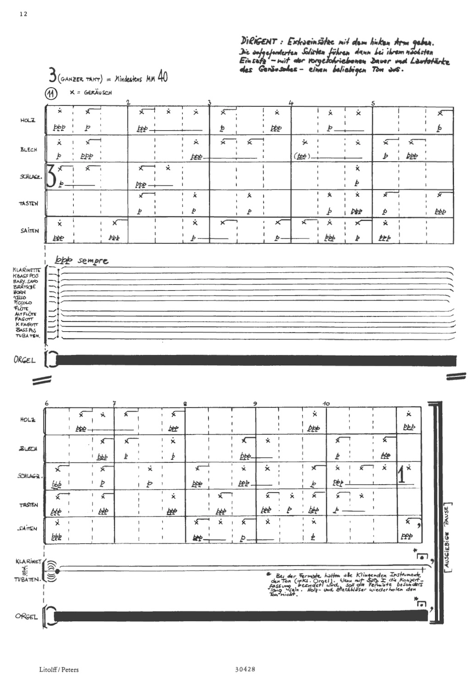
Kagel’s Hétérophonie (1959–61) was written for 42 solo instruments (Kagel liked writing for multiple “soloists”). In an interview, Kagel said that the work was meant to approximate the process of an organist releasing the stops to produce a preset sound. In the score, there’s a “Varèse” stop, a “Schoenberg” stop, and one labeled “Prélude l’apres-midi d’une faune.” The score is filled with graphic symbols. Apparently, the first musicians to perform Hétérophonie were intimidated and confused by it, and they did not hold back on their criticism of the work and of the composer. Kagel decided to show them: he dedicated the piece to “the Marquis de Sade and the West German Radio Symphony Orchestra.” In a rare interview, Kagel explained: “In my writing for this section of the orchestra, I purposefully made the direction and limits of what the players were to do unclear. That means that the musical notation and its realisation are suddenly in conflict. However, I never ask the players to improvise. I greatly admire the skill and inventiveness of jazz musicians like Thelonious Monk, Charles Mingus and Ornette Coleman, but asking classically trained players of New Music to improvise is only relatively possible. The best you can hope for is that they will spontaneously reproduce a given language, and this is also the extent of what many jazz musicians and improvisors can achieve. For real improvisation you have to create a new language, and many improvisors are therefore not as free as they would like.”
Kagel once remarked that Hétérophonie was so dry that “after a few minutes one either turns off or discovers countless delights.” You may find that you can only listen to a bit of this on first hearing. But it is worth revisiting it; Kagel was a composer who looked for a strong reaction from his listeners, and he also was very funny. He said, “Yes, I have a sense of humour, and already as a child I was very suspicious of people who were terribly serious. You know, to say ‘I am serious’ is a quite ridiculous statement, and if someone is ideologically serious it is often a mask. Humour has metaphysical and philosophical dimensions that touch me on a deep level, and I can only take people seriously if they have a sense of humour. In our profession there are many people who use seriousness only to stress how important they are as a composer or a conductor. However, with humour it becomes possible to express a wide spectrum of ideas.”
My classical music post for today is Mauricio Kagel’s Hétérophonie.


Leave a Reply