

The medieval music theorist Guido d’Arezzo developed the four-line music staff—the precursor to the five-line staff—in or around the year 1024. Western art music notation as we know it today would not exist were it not for this revolutionary change. This February, the Daily Classical Music Post will explore music using interesting, unusual, and innovative music notation.
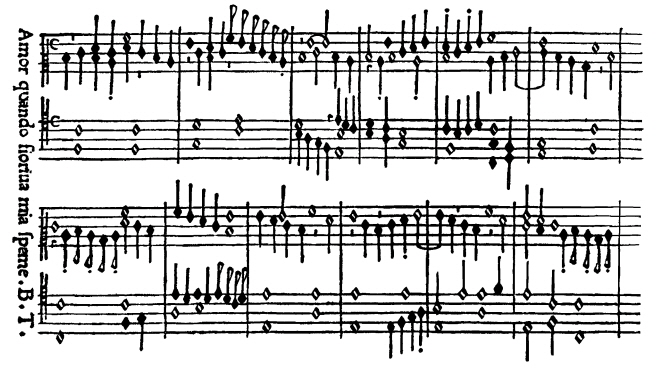
Frottole intabulate da sonare organi, libro primo (Roma 1517) : Che farala che dirala
It would be easy to assume that keyboard notation always looked pretty much like it does today, but for many years it was unnecessary to write down any instrumental music, as it was mostly improvised, just an accompaniment to vocal music.
Christina Kwon said, “It is crucial to understand where the keyboard tablature as a notational system stands in light of all the other systems that were present in 16th-century Europe. . . . [O]ne may assume that it took a long while to arrive at the present-day standard keyboard score. As Apel and Parrish point out, this was already achieved by the early 17th century when the two 5-line staves became the standard notation for the keyboard. . . . However, the system of two 5-line staves was already employed in Andrea Antico’s Frottole intabulate da sonare organi.”
The Italian printer and composer Andrea Antico (c. 1480–after 1538) was the first to publish sacred music in Rome. In particular, he had the exclusive right to print organ tablature in the Papal States. (Kwon: “[It] was important to get the right grip on the instrument, so a type of grip script (Griffschrift) on a tabula, table or a board, plank (Griffbrett), was developed, hence the name tablature (Tabulatur).”) His woodcut method for printing took ages to produce, but it was worth it, as it created high-quality images that have stood the test of time. In addition, Antico composed several frottole, based on Italian popular songs, for the organ. He published the scores in or around 1517. By this time, note lengths and bar lines were part of musical notation, making it even easier for any musician to read and understand.
My classical music post for today is Andrea Antico’s “Che farala che dirala.”


Leave a Reply