

The medieval music theorist Guido d’Arezzo developed the four-line music staff—the precursor to the five-line staff—in or around the year 1024. Western art music notation as we know it today would not exist were it not for this revolutionary change. This February, the Daily Classical Music Post will explore music using interesting, unusual, and innovative music notation.
The Diné composer Raven Chacon (b. 1977) explores the relationships among sound, space, and people. His experimental compositions use a notational language that combines standard Western notation with symbols, guidelines, and other visual elements that are nonmusical.
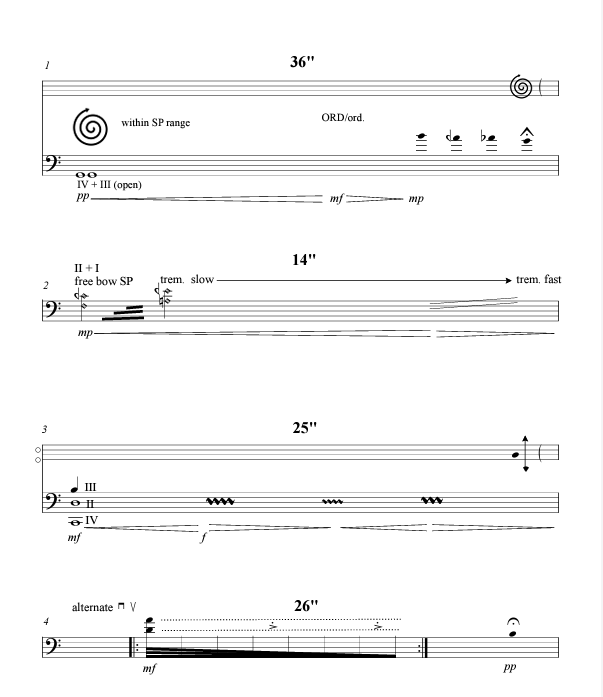
Chacon composed Quiver (2018) for solo cello to a commission by Michelle Kesler. This was one of a three-part series of works on the tracking of animals. Wendalyn Bartley said, “Quiver, Chacon explains, is about conflicting actions, much like what happens when one tries to rub one’s stomach in a circular motion while patting the head. During the hunt, the conflict comes in the trading of one life for another, the need to hunt and kill an animal so one can survive. One instance of this occurs musically when the cellist is asked to perform circular bowing in one direction while drumming with their fingers on the bow.”
In the score, Chacon employs many interesting types of notation, including different wavy lines for vibrato vs. wide vibrato, strangely shaped notes to indicate quarter tones, and arrows to indicate changes in pitch. Whirly shapes tell the performer to use circular bowing, with extra drawings that represent bow position and speed.
My classical music post for today is Raven Chacon’s Quiver.


Leave a Reply