

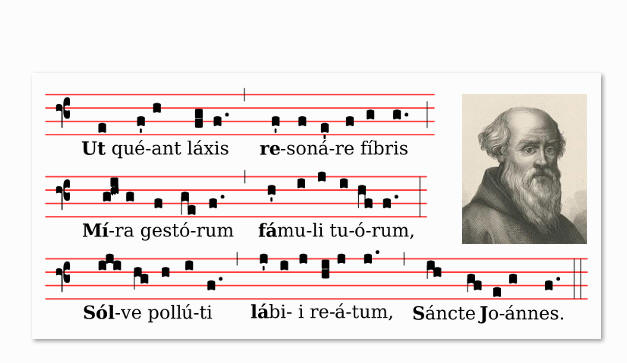
The medieval music theorist Guido d’Arezzo developed the four-line music staff—the precursor to the five-line staff—in or around the year 1024. Western art music notation as we know it today would not exist were it not for this revolutionary change. This February, the Daily Classical Music Post will explore music using interesting, unusual, and innovative music notation.
Guido D’Arezzo – Ut queant laxis
Guido (c. 991–after 1033) recognised that people found the system being used at that time, neumes, really difficult to master. For one thing, neumes didn’t indicate what the actual note was meant to be, and there was no way to tell if one note was higher or lower than the previous one. There were only two lines in the staff at that time, so he added two more, which made it much easier to figure out where the melody was going. He also added rudimentary time signatures.
There still were a lot of things that weren’t exactly clear even in Guido’s system. There weren’t any bar lines, nor was there really any sense of note duration. All that was to come later. But Guido’s system was the predominant one for over 100 years.
And have you ever wondered where that “ut–re–mi–fa–sol–la” (do–re–mi–fa–so–la) thing comes from? Well, that was Guido, too. The syllables come from the first stanza of the hymn “Ut queant laxis.” This was the hexachord that was used in all music of the time (the 7th degree, “ti,” was added in the 19th century). Guido took the hexachord from his earlier invention of what is known as the Guidonian Hand: a method for teaching solfege (giving a whole new meaning to “talk to the hand’”). Wikipedia has a good illustration of the Guidonian Hand if you are interested (https://en.wikipedia.org/wiki/Guidonian_hand).
My classical music post for today is Guido d’Arezzo’s “Ut queant laxis.”


Leave a Reply