

Thank you to everyone who subscribes to and supports the DCMP. This January, I shared some of the more popular posts from 2022 and 2023. A new theme will begin tomorrow!
[First published 20 May 2023]
“That no woman has ever been a great composer is an accepted fact; that she is never likely to become so, more than a probability.”—Anonymous, The Musical Times (1887)
This May, the Daily Classical Music Post will set the record straight. There have been many great women composers, and I’m going to introduce you to just 31 of them and their wonderful music.
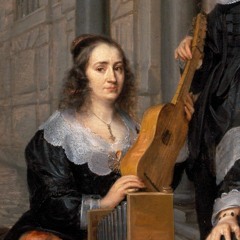
The Flemish composer, lutentist, and singer Leonora Duarte (1610–c. 1678) grew up in a household filled with music, poetry, and art. Duarte was a Portuguese Jewish Converso; her family had left Portugal before she was born to escape the Inquisition. Although her family converted to Catholicism, as a woman and a Jew she never received commissions from the church or the Flemish court. All of her works were composed for performance by her family and musicians who took part in the Duartes’ musical evenings at home.
The Duarte home in Antwerp was so famous throughout Europe that it was given the name “Antwerp Parnassus” by the composer Constantijn Huygens. One visitor recorded in a letter that the “music heard there sounded better than at the house of Monteverdi in Venice.” There is a well-known painting by Gonzales Coques of the family (painted in the 1650s; you can see it here: “Portrait of the Duarte family” Gonzales Coques – Artwork on USEUM). Leonora is the one holding a guitar.
All that is extant of Duarte’s compositions is her set of fantasies for five-part viol consort, the Sinfonias (composed between 1625 and 1650). The Sinfonias are in the late Jacobean style, which makes sense because the English composer John Bull was her tutor while he was director of music at the cathedral in Antwerp. There also is evidence that Duarte was familiar with the works of John Dowland, another famous English composer of music for viols (who lived in self-imposed religious exile on the Continent).
Elizabeth A. Weinfield says that the Sinfonias are “the only known seventeenth-century viol music written by a woman and testament to a formidable talent for composition.” Sinfonia No. 3 is perhaps the most interesting and complex of the seven works. Imitative free counterpoint is interspersed with homophonic and homorhythmic sections. Although all we have is the Sinfonias, we can easily understand that, had circumstances been different, Leonora Duarte would have composed some truly extraordinary music for other instrumentation.
My classical music post for today is Leonora Duarte’s Sinfonia No. 3.


Leave a Reply