

Hale Smith: Toussaint L’Ouverture, 1803
First posted 22 July 2020
This July, the Daily Classical Music Post will celebrate Black composers whose music has been suppressed and ignored. #DecolonizeTheClassicalMusicCanon #DevelopAnAntiracistMusicTheoryCurriculum #DismantleWhiteSupremacy
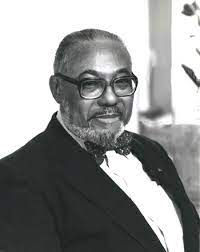
Hale Smith (1925–2009) studied at the Cleveland Institute of Music (BMus and MMus). His distinguished career is detailed by a former student, Marilyn Harris, on her website (http://www.marilynharris.com/). His early training on the piano included jazz as well as classical music, and this is evident in many of his compositions. His first jobs following graduation were in the music publishing business as an editor. He worked for several different publishers in New York City in the late 1950s and 1960s. He once described himself as “one of America’s most famous unknown composers.”
His compositions reveal a wide range of knowledge of many different styles, ranging from serial works like his Contours for Orchestra to lyrical works like The Valley Wind for voice. He received many awards and also advised several organizations on the importance of diversity in music. However, he once said, speaking about how music of Black composers should feature on programs regularly, “We don’t even have to be called black. When we stand for our bows, that fact will become clear when it should — after the music has made its own impact.”
Paul Horsley said of Smith’s Toussaint L’Ouverture, 1803 (composed in 1979): “Toussaint L’Ouverture, 1803, . . . is a choral paean to the great black hero of Haiti, with a tragedy-tinged text by Adelaide Simon. . . . Its dense harmonies are imbued with sensitive text-paining and a glowing conclusion depicting the death of the imprisoned Toussaint.” Written for SATB choir and piano, the opening harmonies are in a sense reminiscent of Britten, and there are some Howellsian moments throughout, but the overall voice is unmistakably that of Smith.
The Amaryllis lilies
Josephine brought up from Martinique
spike through this winters gloom.
Napoleon and his ministers
range down Malmaisons halls,
not stopping at the bloom.
The scarlet, roaring flames of flowerheads
that shatter the pink damask
and the white sheer muslin.
In a prison while the tyrant strides
prating of empire,
Toussant in ankled mire longs for the sun
and torched flamboyant trees.
All winter the Black Liberator lingers,
heartsick and cold
remembering flowers of fire and freedom
rocketing in Western skies,
and this White Prince who lies.
So when the spring sends out her first thing fingers
He turns upon his cot, and coughs, and die
My classical music post for today is Hale Smith’s Toussaint L’Ouverture, 1803.


Leave a Reply