

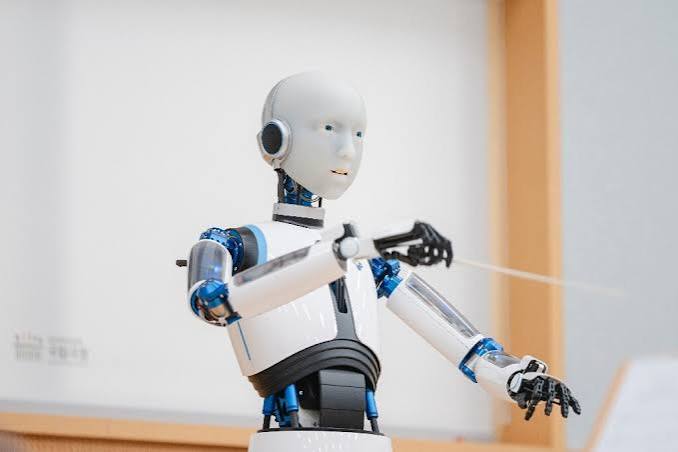
Throughout human history, technological developments have transformed the ways we live, work, communicate, and create. This November, the Daily Classical Music Post will explore compositions inspired by or made possible through many of these innovations and inventions, discovering how the changing world has shaped the music we make and hear.
Robert Laidlow (2022): Silicon
Throughout November, we’ve explored how technology has transformed music, from the earliest tools and mechanical instruments to electronic sound, computers, and artificial intelligence. Today’s work brings many of these developments together. The British composer Robert Laidlow (born 1994) composed Silicon, a large-scale composition for symphony orchestra and artificial intelligence, in 2022. He explored what happens when one of classical music’s oldest and most established institutions encounters one of the newest forms of technology. Silicon received its premiere on 29 October 2022 at Manchester’s Bridgewater Hall, performed by the BBC Philharmonic under the direction of Vimbayi Kaziboni.
Laidlow studied music at Cambridge University and composition at the Royal Academy of Music. Between 2018 and 2022, he undertook doctoral research at the Royal Northern College of Music’s Centre for Practice and Research in Science and Music (PRiSM), working in association with the BBC Philharmonic. His research explored how AI might participate in the creative process, not merely by generating musical material but also by challenging composers to reconsider familiar ideas about authorship, originality, and musical expression. Silicon emerged from this research and uses AI in several different ways: as a compositional assistant, an electronic instrument, an improvising participant, and a source of inspiration.
The approximately 40-minute work has three movements, titled Mind, Body, and Soul. The first, Mind, begins with musical material created through a combination of human composition and artificial intelligence. Laidlow uses these ideas to explore the relationship between the symphony orchestra’s long history and its possible future. The music moves between recognisable orchestral gestures and passages that seem strangely distorted or unfamiliar, as though centuries of musical tradition were being examined through a technological lens. Rather than simply reproducing established symphonic forms, Laidlow asks what new possibilities might emerge when a composer allows artificial intelligence to contribute unexpected ideas.
The second movement, Body, explores questions of authenticity and control. Here Laidlow draws inspiration from the increasingly familiar phenomenon of deepfakes, AI-generated images, videos, or sounds that convincingly imitate something real. He developed an electronic instrument capable of transforming its sound to resemble different orchestral instruments. Meanwhile, the music moves rapidly between contrasting dance styles, including big-band jazz, electronic dance music, and folk-inspired material. These abrupt changes reflect the experience of navigating social media, where algorithms continually direct our attention towards something new. The orchestra sometimes seems almost like a puppet, its movements controlled by an invisible technological presence.
For the final movement, Soul, Laidlow did something quite different. He obtained access to approximately 2,000 hours of recordings from the BBC Philharmonic’s broadcasting archive and used them to train an AI system. The resulting sounds weren’t simply imitations of individual instruments or passages of orchestral music. They also included unexpected traces of the orchestra’s wider musical life: fragments resembling radio announcers, musicians tuning their instruments, and audiences applauding. These sounds became part of the composition, creating an eerie impression of the orchestra listening to its own past. The technology had absorbed not only the music but also the human activities surrounding its performance.
Silicon raises a very interesting question: What exactly makes an orchestra an orchestra? Is it simply a collection of instruments and musicians, or is it also the accumulated history of rehearsals, concerts, recordings, audiences, and shared experiences? Laidlow suggests that AI can act as a mirror, reflecting aspects of musical life that we might otherwise overlook. He doesn’t present the technology as a replacement for human musicians. Instead, he uses it to investigate what is distinctive about human musical creativity and the communities that sustain it. Silicon reminds us that the relationship between humans and machines is not simply a story of technological progress. It is also a continuing conversation about creativity, identity, and what we value in music.
My classical music post for today is Robert Laidlow: Silicon.


Leave a Reply