

Throughout human history, technological developments have transformed the ways we live, work, communicate, and create. This November, the Daily Classical Music Post will explore compositions inspired by or made possible through many of these innovations and inventions, discovering how the changing world has shaped the music we make and hear.
Edgard Varèse: Ionisation (1929–31)
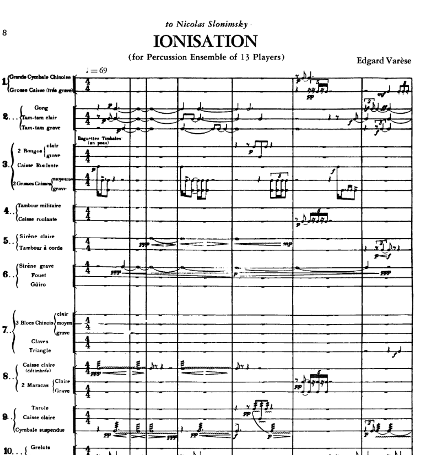
In the early 20th century, the sounds of modern life were changing dramatically. Factories, motorcars, aeroplanes, and electrical machinery were creating an entirely new acoustic environment, and composers were beginning to question why music should remain confined to the sounds of traditional orchestral instruments. Among the most radical was the French-born composer Edgard Varèse (1883–1965), who settled in New York in 1915 and devoted much of his career to exploring what he called organised sound. His Ionisation, composed between 1929 and 1931, is one of the landmarks of 20th-century music, written for 13 percussionists playing an extraordinary assortment of instruments, including two sirens.
Varèse had originally been encouraged to pursue science and engineering, and his fascination with physics remained central to his musical imagination. The title Ionisation refers to the process by which an atom or molecule acquires an electrical charge through the loss or gain of electrons. Varèse wasn’t attempting to illustrate a scientific experiment literally. Instead, he was fascinated by the idea of energy, movement, and transformation, imagining musical sounds as masses that could collide, separate, and combine. Rather than developing melodies in the conventional sense, he organised rhythms and contrasting timbres into a constantly shifting structure.
The instrumentation is fascinating: drums of various sizes, gongs, cymbals, anvils, woodblocks, maracas, castanets, a whip, and a lion’s roar, an unusual percussion instrument that produces a deep, growling sound. There are also two sirens with changing pitches that introduce an unsettling mechanical element. For much of the work, Varèse relies on instruments without definite pitch, creating intricate layers of rhythm and contrasting sonorities. Towards the end, the unexpected appearance of piano, glockenspiel, and tubular bells introduces a more clearly pitched dimension. The music builds towards a powerful conclusion in which the different sounds seem to converge into a single, overwhelming mass.
Ionisation received its premiere on 6 March 1933 at Carnegie Chapter Hall in New York, conducted by Nicolas Slonimsky, to whom the work is dedicated. But assembling an ensemble capable of performing it presented an unusual problem. There were relatively few specialist percussionists available, so Slonimsky recruited a remarkable collection of fellow composers and instrumentalists. When the work was recorded in 1934, the participants included Henry Cowell, Paul Creston, William Schuman, and the celebrated flautist Georges Barrère. Varèse himself operated the sirens. Schuman later joked that Slonimsky had launched his musical career by entrusting him with the lion’s roar, but apparently he hadn’t performed well enough to be invited back!
Even the sirens caused complications. According to Slonimsky’s recollections, Varèse obtained manually operated sirens through a retired New York firefighter, allowing their pitches and volume to be controlled during performance. A proposed radio broadcast ran into an unexpected obstacle: the authorities restricted the broadcasting of fire-siren signals. It’s a wonderful illustration of how thoroughly Varèse was challenging the conventional boundaries of musical performance. Instruments associated with emergencies, factories, and everyday life were being brought into the concert hall and treated as legitimate musical resources.
Although Ionisation is often described as the first composition for percussion ensemble alone, there were earlier experiments, including works by Alexander Tcherepnin and the Cuban composer Amadeo Roldán. Nevertheless, Varèse’s piece became enormously influential, demonstrating that percussion could provide not merely rhythmic accompaniment but the entire substance of a composition. His ideas anticipated later developments in electronic music, when composers would gain unprecedented control over the creation and manipulation of sound itself.
My classical music post for today is Edgard Varèse: Ionisation.


Leave a Reply