

Throughout human history, technological developments have transformed the ways we live, work, communicate, and create. This November, the Daily Classical Music Post will explore compositions inspired by or made possible through many of these innovations and inventions, discovering how the changing world has shaped the music we make and hear.
George Lewis – Voyager [1987/2018] | International Contemporary Ensemble
The American composer, trombonist, and musicologist George E. Lewis (born 1952) has spent much of his career exploring the relationship between improvisation, technology, and African American musical traditions. Born in Chicago, he became involved with the Association for the Advancement of Creative Musicians (AACM) while still a teenager, joining the organisation in 1971. Founded on Chicago’s South Side in 1965, AACM encouraged musicians to experiment freely with composition, improvisation, and unconventional instruments. Its members included some of the most adventurous figures in American experimental music, among them Anthony Braxton, Roscoe Mitchell, and the Art Ensemble of Chicago. This extraordinary musical environment would have a profound influence on Lewis’s work.
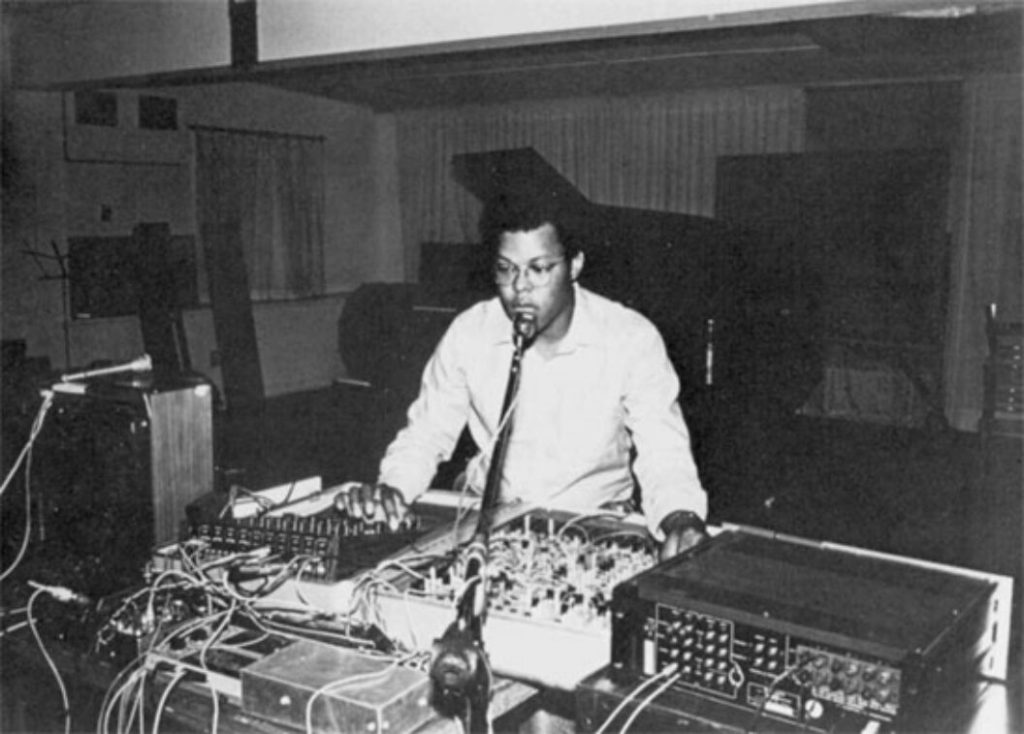
Lewis began experimenting with computers in the late 1970s, at a time when the idea of a machine participating in spontaneous musical improvisation seemed almost unimaginable. During the early 1980s, he worked at IRCAM in Paris, developing computer systems that could respond to human musicians. He subsequently continued his research at STEIM, the experimental electronic music centre in Amsterdam. In 1987, he introduced Voyager, an interactive computer-music system designed to improvise alongside human performers. Unlike earlier computer-generated compositions, Voyager wasn’t simply producing notes according to a predetermined sequence. It was intended to behave as an independent musical participant.
The system listens to a human improviser, analyses elements such as pitch, rhythm, and musical activity, and uses that information to generate its own responses. But here’s the particularly interesting part: Voyager doesn’t always follow the human performer. It can introduce entirely new musical ideas, change direction unexpectedly, or continue playing when the musician stops. Early versions used synthesizers to create what Lewis described as a virtual improvising orchestra, capable of producing multiple instrumental voices simultaneously. Later versions could operate a computer-controlled acoustic piano. Each performance is different because the musical decisions emerge from the interaction between the performer and the software.
There’s a wonderful story about Lewis’s early experiments. He recalled hearing several computers improvising together and being struck by how much they resembled a group of musicians from AACM. The machines seemed to produce the same kinds of unexpected combinations, contrasting ideas, and spontaneous musical exchanges that he valued in human ensembles. Rather than trying to make computers imitate conventional classical compositions, Lewis was exploring whether they could participate in the collective creativity central to his own musical experience.
This is an important distinction, particularly when we consider the history of African American experimental music. Lewis has argued that musical technologies are never culturally neutral: the assumptions built into them reflect the values and experiences of the people who create them. Voyager was therefore not simply an exercise in computer programming. It embodied ideas about improvisation, collaboration, and individual musical identity that Lewis had developed through his involvement with AACM. His research also challenged the tendency to discuss technological innovation in music primarily through European and American classical traditions, overlooking the contributions of Black experimental musicians.
Lewis’s work continues to evolve: in 2022, he collaborated with researchers at the Royal Northern College of Music in Manchester to develop Forager, a new interactive system incorporating advances in machine learning. From the earliest computer experiments to contemporary artificial intelligence, Lewis has consistently explored not how machines might replace musicians but also how they might expand the possibilities of musical creativity.
My classical music post for today is George E. Lewis: Voyager.


Leave a Reply