

Throughout human history, technological developments have transformed the ways we live, work, communicate, and create. This November, the Daily Classical Music Post will explore compositions inspired by or made possible through many of these innovations and inventions, discovering how the changing world has shaped the music we make and hear.
Henry Cowell – Rhythmicana (Cahill) (1938)
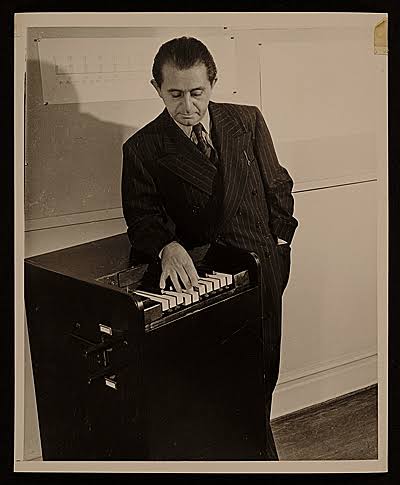
The American composer Henry Cowell (1897–1965) was one of the great musical experimenters of the 20th century. Already famous for his tone clusters, produced by striking groups of adjacent piano keys with his hands, fists, or forearms, he became fascinated by complex polyrhythms: independent rhythmic patterns sounding simultaneously, sometimes in combinations almost impossible for human musicians to perform. His solution was to commission an entirely new musical instrument.
In 1930, Cowell approached the Russian-born inventor Léon Theremin, whose electronic instrument we’ve encountered before in the Daily Classical Music Post through Anis Fuleihan’s Concerto for Theremin and Orchestra, written for Clara Rockmore. Theremin developed the Rhythmicon, a keyboard instrument using rotating perforated discs, light, and photoelectric cells to generate rhythmic sounds. Its 16 principal keys produced different numbers of beats, allowing extraordinarily complicated rhythmic patterns to be combined. It was one of the earliest electronic rhythm machines, decades before drum machines became familiar in popular music. You can watch Andrei Smirnov demonstrating Theremin’s Rhythmicon in this fascinating video.
There’s a wonderful connection with Charles Ives, another composer fascinated by complex rhythms. Ives helped finance a second Rhythmicon for Cowell and the conductor Nicolas Slonimsky. In a January 1932 letter, he explained that he’d sent Theremin the money and that the instrument would belong to Cowell and Slonimsky. He added, rather charmingly, that he simply wanted to help and sit under its shadow on a nice day! Despite attracting considerable curiosity, the Rhythmicon proved unreliable and never became widely adopted.
In 1931, Cowell composed Rhythmicana, a concerto for Rhythmicon and orchestra. But the work never received a complete orchestral performance during his lifetime. Its documented premiere finally took place at Stanford University in 1971, six years after his death. By then, the original instrument was no longer a practical option, so composer and computer-music pioneer Leland Smith used a PDP-10 computer to reproduce the Rhythmicon part on tape, accompanying the Stanford Symphony Orchestra. A composition written for one of the earliest electronic musical instruments had to wait 40 years for another technology to make its performance possible!
The Rhythmicana we’re listening to today, however, is a separate work for solo piano, composed in 1938. Dedicated to the German-born composer Johanna Beyer, it explores similarly complex rhythmic relationships without the electronic instrument. Its three movements include striking tone clusters, conflicting rhythmic patterns, and passages in which the pianist’s hands follow different metres. Although the two compositions share a title, they are independent works, united by Cowell’s lifelong fascination with rhythm.
Cowell, like other composers we discovered this month, recognised that machines could realise musical ideas beyond the physical limitations of human performers. The Rhythmicon itself was ultimately a technological dead end, but the questions that Cowell was asking about rhythm, mathematics, and mechanical performance would continue to shape experimental music for generations.
My classical music post for today is Henry Cowell: Rhythmicana (1938).


Leave a Reply