

Throughout human history, technological developments have transformed the ways we live, work, communicate, and create. This November, the Daily Classical Music Post will explore compositions inspired by or made possible through many of these innovations and inventions, discovering how the changing world has shaped the music we make and hear.
Camberwell Beauty ~ Sarah Angliss ~ from Ealing Feeder
The British composer, performer, and sound artist Sarah Angliss (born 1966) has an unusual combination of interests. She studied Baroque and Renaissance music, performed in folk clubs, and trained in electroacoustic engineering and robotics. Her compositions bring together historical musical instruments, electronics, and machines she designs and builds herself. Rather than relying entirely on computer-generated sounds, Angliss likes to create mechanical instruments that can perform alongside her on stage, producing music that is both technologically sophisticated and physically present.
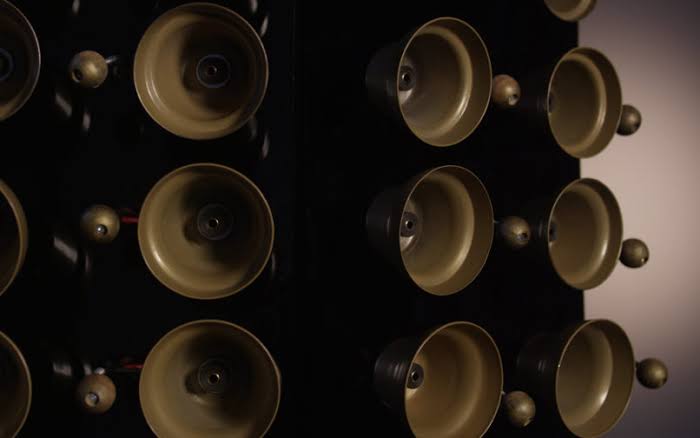
One of her most remarkable inventions is the Ealing Feeder, a robotic carillon consisting of 28 tuned bells. A traditional carillon is a musical instrument in which bells are played through a keyboard or mechanical mechanism, usually housed in a tower. Angliss’s version is small enough to take on tour and is controlled by software she developed herself. Its mechanical beaters can strike the bells in extraordinarily rapid and complex patterns, far beyond the capabilities of a human performer. She originally created the instrument for a commission celebrating the reopening of London’s Royal Festival Hall in 2007, and has subsequently rebuilt and refined it several times. Its name comes from a control in the old Battersea Power Station, which once supplied electricity to parts of west London.
Camberwell Beauty appears on Angliss’s 2017 album Ealing Feeder, a collection inspired by the history, folklore, and sounds of London. The title has a particularly touching story behind it. Several years earlier, Angliss had been forced to sell her piano to pay the rent. Someone subsequently gave her an old piano from Camberwell, a district of south London. Although the instrument was in such poor condition that she couldn’t use it on the album, it encouraged her to begin playing again.
The bells heard in Camberwell Beauty are played by the Ealing Feeder. Angliss programmed the machine to produce intricate patterns, including a technique she calls a double, in which each note is echoed on the half-beat at a different pitch. The resulting overlapping sounds create a shimmering, sometimes almost blurred, musical texture. Although the patterns are controlled by a computer, the sounds themselves come from real bells being struck by moving mechanical parts. Angliss particularly values the tiny irregularities in timing and sound that result from these physical movements, qualities she believes would be difficult to reproduce convincingly with digital samples.
There is an interesting connection here with Joseph Haydn’s mechanical clocks and Wolfgang Amadeus Mozart’s mechanical organ. All three involve machines that can perform music automatically, but Angliss combines that centuries-old idea with modern software and robotics. Her instruments also allow her to perform live alongside the machines, creating a musical partnership between human and mechanical performers. And behind all this technological ingenuity is the simple story of an old piano that helped a musician rediscover the pleasure of playing.
My classical music post for today is Sarah Angliss: Camberwell Beauty.


Leave a Reply