

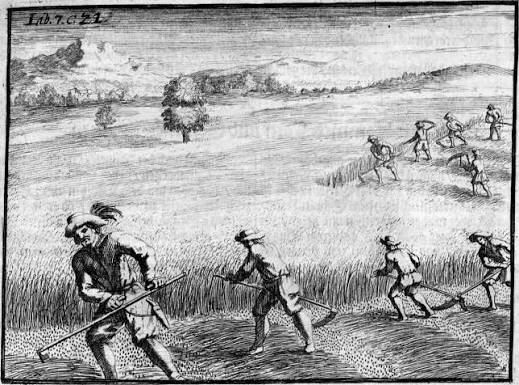
For millennia, the rhythms of planting and harvest have shaped human life, marking seasons of labour, renewal, abundance, and gratitude. This October, the Daily Classical Music Post will journey across eras and continents, celebrating harvest in the Northern Hemisphere and planting in the Southern through music inspired by the Earth and its changing seasons.
Album For The Young, Op. 68, No. 18: Schnitterliedchen
Robert Schumann (1810–1856) was one of the central figures of German Romanticism, equally important as a composer and influential music critic. Although he wrote symphonies, chamber music, and hundreds of songs, the piano occupied a particularly important place in his career. Many of his best-known piano works use short character pieces to suggest a scene, personality, or emotion in just a few minutes.
Schnitterliedchen (Little Reaper’s Song) is a tiny piano piece depicting the people whose job it was to cut the ripened crop. It is No. 18 of Schumann’s Album für die Jugend (Album for the Young), Op. 68, composed in 1848. The collection began with pieces Schumann wrote for his daughter Marie and eventually grew into 43 short piano works. It is divided into two sections, the first intended for younger players and the second for more advanced ones. Schnitterliedchen is the final piece in the easier first section.
The German word Schnitter means a reaper—traditionally someone cutting grain with a sickle or scythe—while Liedchen means “little song.” There are no words and no actual reapers in this piece: Schumann leaves it to the pianist to suggest the reaper’s activity.
Marked “Nicht sehr schnell” (not very fast), the piece has a steady, purposeful motion rather than frantic speed. Its short phrases and repeated rhythmic patterns give the impression of regular physical movement, rather like the repeated sweep of a tool cutting through standing grain. The melody has the uncomplicated character of a folk song, while the accompaniment keeps the music moving steadily forward. There is no grand climax or Romantic drama; the scale and simplicity are entirely appropriate to a scene of ordinary rural work.
Interestingly, Schumann returned to the subject later in the same collection: No. 24 is Ernteliedchen, or “Little Harvest Song.” Reaping and harvesting were part of the rural world Schumann wanted young pianists to encounter alongside hunters, riders, sailors, and peasants.
Unlike some of the more elaborate works depicting harvesting, in this piece Schumann needs barely a minute to describe the activity. The grain is ripe, the reapers are at work, and their repeated movements become a little song of their own.
My classical music post for today is Robert Schumann: Album für die Jugend, Op. 68: Schnitterliedchen.


Leave a Reply