

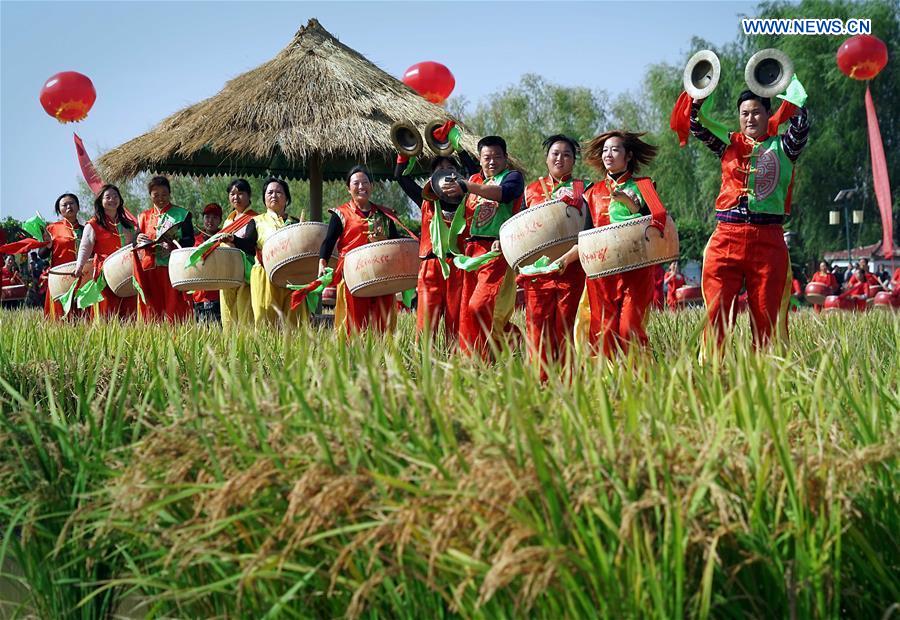
For millennia, the rhythms of planting and harvest have shaped human life, marking seasons of labour, renewal, abundance, and gratitude. This October, the Daily Classical Music Post will journey across eras and continents, celebrating harvest in the Northern Hemisphere and planting in the Southern through music inspired by the Earth and its changing seasons.
Harvest Ensemble of Gongs and Drums 丰收锣鼓
Peng Xiuwen (1931–1996) was one of the most important figures in the development of the modern Chinese orchestra. As a conductor, composer, and arranger, he played a major role in developing an ensemble that brought traditional Chinese instruments together on an orchestral scale. Cai Huiquan (1925–1990) was a percussion specialist with the China Broadcasting Chinese Orchestra whose background included the percussion traditions associated with Kunqu opera. He was also involved in the development of the paigu, tuned Chinese drums that feature prominently in modern Chinese orchestral music.
Harvest Gongs and Drums (Fengshou Luogu, 丰收锣鼓) was composed in 1972. The music depicts both the activity of people working during the harvest and their exhilaration at a bumper crop, using the brilliant colours of Chinese wind, string, and percussion instruments to create an exciting musical harvest celebration.
The work draws upon the traditions of Chinese chuida—literally “blowing and striking”—ensembles, in which wind instruments and percussion combine to produce music of tremendous rhythmic energy. Peng and Cai take rhythmic and melodic ideas associated with traditional gong-and-drum music and expand them for the resources of the full Chinese orchestra. Percussion isn’t simply providing accompaniment here: it is one of the principal characters in the music.
The work falls into four broad sections. A powerful, brilliant introduction immediately announces the festive atmosphere, with drums and the penetrating sound of the suona helping to establish the celebration. This leads into more melodic music depicting the bustle of the harvest. The central section is more lyrical. The use of the yunluo, a set of small tuned gongs, is particularly beautiful: the arpeggiated sounds that they make have been described as suggesting sunlight shimmering on water. The final section draws on several Chinese percussion traditions, building the rhythmic excitement until the entire orchestra is caught up in the celebration. After the repetitive labour represented earlier in the piece, the ending gives us the reward: the harvest has been abundant, and no one has any intention of celebrating it quietly.
My classical music post for today is Peng Xiuwen and Cai Huiquan: Harvest Gongs and Drums.


Leave a Reply