

Throughout history, myths and legends have brought ancient mysteries and epic sagas to life. This September, the Daily Classical Music Post will explore how composers from different eras and continents have reimagined these stories through the universal language of music.
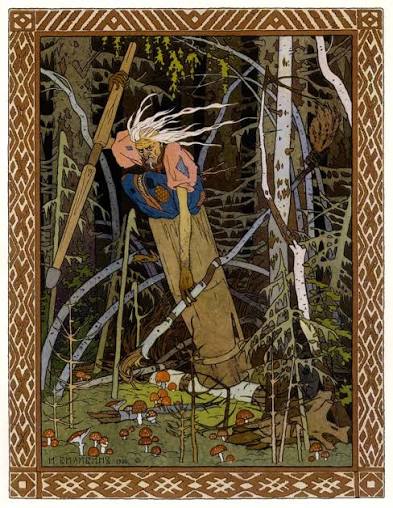
Some mythological creatures can be either good or bad, depending on the tale. One such figure in Slavic folklore is the supernatural witch Baba Yaga, who is said to live in the depths of the forest in a rotating hut that stands on giant chicken legs. She is sometimes described as having one “bony leg” that is a direct link to the underworld. Some stories have her threatening to eat lost children, while others have her rewarding brave heroes after helping them in their quests, but she is almost always described as terrifying. Baba Yaga’s unique method of travel has her flying around inside a giant mortar, wielding a pestle and sweeping away her tracks with a birch broom.
The Russian composer and conductor Anatoly Lyadov (1855–1914) studied composition with Nikolai Rimsky-Korsakov and was one of the group of Russian composers who succeeded The Five, continuing the Russian nationalist musical style established by the older composers. Lyadov traveled across Russia to research, collect, and preserve authentic rural folk music. He frequently chose Russian national themes and folk tales for his compositions; in fact, his late orchestral works are almost entirely based on Russian folklore, fairy tales, and folk melodies.
Lyadov’s orchestral miniature Baba Yaga, Op. 56 (1904) took as his inspiration an extract from a story by Alexander Adanassiev: “Stealing out on another of her jaunts, Baba Yaga, the forest witch, utters a wonted whistle to bring mortar, pestle and broomstick scurrying to the scene. Through the forest she glides seated in the mortar, using the pestle to drive her swiftly on her way, the broom to smoothen all traces left behind by her unusual conveyance. The cracking of trees accompanies the rustle of dry leaves littering the ground. Soon the whole forest is alive with sound.”
Baba Yaga begins with some short sharp chords, and then a creeping bassoon enters (representing Baba Yaga). The music accelerates, depicting Baba Yaga’s takeoff, and the flutes and piccolo shrieks represent the howling winds. The full orchestra depicts the witch flying frantically through the air. The falling chromatic lines represent her sweeping away her tracks. And then, the music stops abruptly as Baba Yaga disappears into the night.
Baba Yaga is considered to be one of the best of Lyadov’s late-career tone poems. His orchestration reveals that he definitely listened to and learned from his teacher Rimsky-Korsakov. And there also are hints of the avant-garde language that Igor Stravinsky would adopt and make famous in the not-too-distant future.
My classical music post for today is Anatoly Lyadov: Baba Yaga, Op. 56.


Leave a Reply