

Throughout history, myths and legends have brought ancient mysteries and epic sagas to life. This September, the Daily Classical Music Post will explore how composers from different eras and continents have reimagined these stories through the universal language of music.
Enchanted Forest Suite: IV. Unicorn
No animal has quite captured the imagination of the world quite like the legendary unicorn. The unicorn is usually depicted as a white horse with a single horn on its head and it first appeared in Greek writing some time around 400 BCE. It’s possible that these early unicorns were based on animals like the rhinoceros, or maybe some kind of prehistoric horned animal. By the Middle Ages, people in Europe believed that unicorns were real, and thought that they were symbols of purity and grace. The unicorn horn was said to have magical powers. The unicorn was revered in Celtic mythology, and Scottish monarchs adopted the animal as a symbol of the strength and authority of the sovereign nation. There are many stories about the unicorn, but perhaps the saddest is the one that dozens of cartoonists have immortalized: of all the creatures on Earth at the time of the biblical Great Flood, only one pair missed the boat: the unicorn.
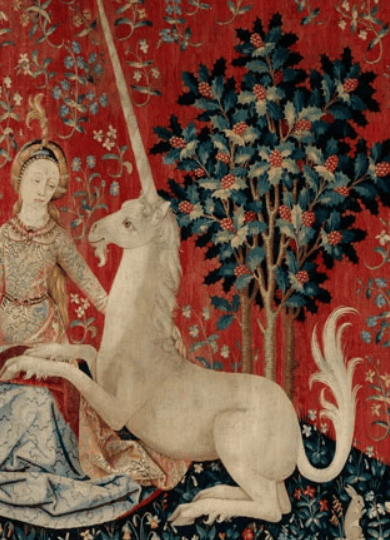
One of the most famous legends of the unicorn is the medieval “Maiden’s Capture”; as unicorns are so swift, no hunter could capture it. However, if a young maiden of pure heart was left sitting alone in the forest, a unicorn would approach and rest its head in her lap. Hunters then used this trust to ambush and capture the unicorn. This legend was immortalized in the late-15th-/early-16th-century Unicorn Tapestries, and probably dates from a book called Physiologus, probably written around 200 BCE in Alexandria.
The American composer J. Mark Scearce (born 1960) is particularly known for his settings of vocal works, including art songs, opera, and large-scale chorus and orchestral pieces, but he also has composed many chamber works. His music is accessible and highly descriptive. He has been lauded for his ability to weave theological and philosophical themes into his works, blending resonant harmonies and modal textures without adhering to any one particular genre.
One of his earliest works is a four-movement brass quintet, the Enchanted Forest Suite, composed in 1991 for the Chicago Brass Quintet. The final movement, “Unicorn,” is the longest of the four movements. Scearce uses sweeping and expansive melodic lines that bring to mind a majestic creature floating through the trees, leading hunters on a fruitless chase. The movement ends quietly and gently, and you can almost imagine that the unicorn has approached the young girl and laid its head in her lap. Some editions of the sheet music for the suite call this movement “Flight of the Unicorn,” but I don’t think that extra description is needed.
My classical music post for today is J. Mark Scearce: Enchanted Forest Suite: IV. Unicorn.


Leave a Reply