

Throughout history, myths and legends have brought ancient mysteries and epic sagas to life. This September, the Daily Classical Music Post will explore how composers from different eras and continents have reimagined these stories through the universal language of music.
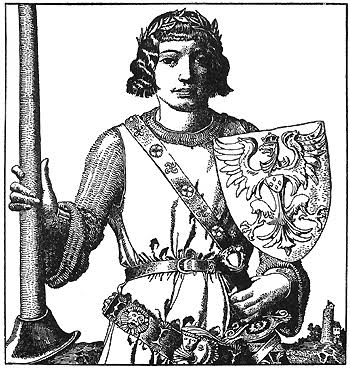
The legend of Percival changed a lot from its earliest tellings in Celtic and Welsh mythology through Chrétien de Troyes’ unfinished French chivalric romance, Perceval, the Story of the Grail (c. 1190), Wolfram von Eschenbach’s 25,000-line German chivalric epic poem titled Parzival (c. 1200–1210), and Sir Thomas Malory’s Le Morte d’Arthur. The basic story of the naive youth who becomes an Arthurian knight mostly stayed the same, but his quest for the Holy Grail and how that all played out is very different depending on the writer and the particular geopolitical and religious environments in which they lived and worked.
And then, in the 1880s, the German composer Richard Wagner (1813–1883) took von Eschenbach’s epic and made some sweeping changes to the story for what is considered to be one of his masterpieces, the three-act music drama Parsifal (1882). Wagner had actually begun work on Parsifal 25 years earlier, but he put it aside several times to work on his other compositions as well as develop his festival hall in Bayreuth.
Wagner made the Holy Grail and Holy Spear the central focus of the plot. He created the villain Klingsor, a fallen knight. He set up Parsifal to save an entire religious order, not just the wounded King Amfortas. He also added the character of Kundry, a woman who has been cursed for all eternity and is forced to serve Klingsor, and has her attempt to seduce Parsifal. And there is a happy(ish) ending: Parsifal returns to the Grail Castle, heals King Amfortas, and becomes the new king, bringing forgiveness and spiritual redemption to everyone.
Wagner did not call Parsifal an opera, instead naming it a Bühnenweihfestspiel (Festival Play for the Consecration of the Stage). He composed the music specifically for the acoustics of Bayreuth, and he mandated that the work could not be performed anywhere else for 30 years. The Metropolitan Opera in New York City defied that ban in 1902, leading to Wagner’s widow Cosima blacklisting everyone involved in that unauthorized production from ever appearing at Bayreuth again.
The wonderful Prelude to Act I sets the mood brilliantly. Wagner introduces several of the themes to be heard later, including the Theme of the Holy Supper, the Dresden Amen, and the Theme of the Sacred Spear. I get goosebumps every time I hear the Prelude. It is a masterclass in musical suspense, and shows Wagner’s genius in using silences and pauses to draw in the listener.
My classical music post for today is Richard Wagner: Parsifal: Prelude.


Leave a Reply