

Throughout history, myths and legends have brought ancient mysteries and epic sagas to life. This September, the Daily Classical Music Post will explore how composers from different eras and continents have reimagined these stories through the universal language of music.
La Pellegrina 1589, Erster Teil, Terzo Intermedio: Marenzio/ Rinuccini: – Qui Di Carne Si Sfama
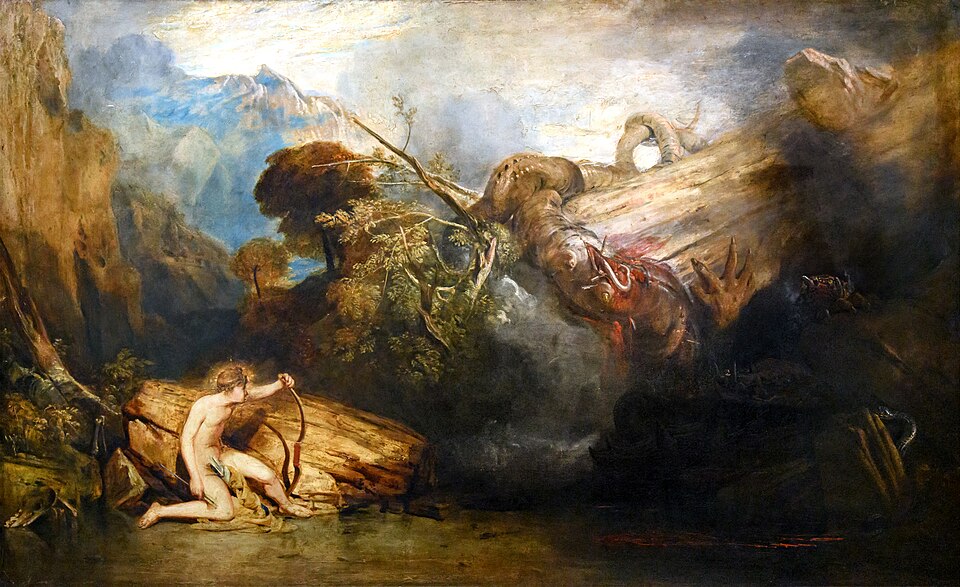
In Greek mythology, Python was a massive dragon-serpent tasked by its mother, Gaia, to guard the sacred oracle of Delphi at the centre of Earth. Apollo, the young archer god, wanted to establish his own oracle, so he chased Python to its cave and killed it. Apollo then took over the sanctuary, establishing his Pythian Oracle, and he also celebrated his triumph by instituting the Pythian Games. This famous story was the subject of statues in the Greek and Roman eras as well as more modern paintings, most notably those by Eugène Delacroix, Peter Paul Rubens, and J.M.W. Turner (the image that accompanies today’s post).
Greek myths were incredibly popular subjects for Renaissance composers, especially during the late 16th century. This fascination directly led to the development of opera. As Renaissance humanists studied ancient Greek texts, they became obsessed with the idea that ancient music had the magical power to stir human emotions. Composers turned to classical mythology to achieve this dramatic emotional impact.
In 1589, to celebrate the wedding of Grand Duke Ferdinando I de’ Medici and Christine of Lorraine in Florence, several composers and poets collaborated on a lavish production, the intermedio La Pellegrina. An intermedio was a spectacular musical and theatrical performance complete with singing, dancing, and special effects, staged between acts of a play in Renaissance Italy. The composers who contributed to the six intermedii were some of the finest composers in Italy at the time: Cristofano Malvezzi, Luca Marenzio, Emilio de’ Cavalieri, Jacopo Peri, Giulio Caccini, Giovanni de’ Bardi, and Antonio Archilei.
Intermedio 3, “Apollo Slaying the Python,” was composed by Luca Marenzio (1553–1599) with text by Ottavio Rinuccini. Marenzio was a master of madrigal writing in particular, and his brilliance can be heard throughout this piece, which is in three sections. Section 1 is the citizens of Delos weeping and lamenting as they are terrorized by Python. Section 2 is instrumental and featured an aerial dancer playing Apollo and a massive fire-breathing Python (also a dancer). The final section is a joyful celebratory song, performed by the grateful citizens. And, of course, given that this was Renaissance Florence, there were political undertones to Intermedio 3: Python represented chaos and the enemies of Florence, and Apollo represented Grand Duke Ferdinando. The guests all understood the message: under Medici rule, chaos and enemies would be conquered, and a Florentine “Golden Age” would be guaranteed.
My classical music post for today is Luca Marenzio: La Pellegrina, Intermedio 3, 1. “Qui di carne si sfama.”


Leave a Reply