

Throughout history, myths and legends have brought ancient mysteries and epic sagas to life. This September, the Daily Classical Music Post will explore how composers from different eras and continents have reimagined these stories through the universal language of music.
[Chen Yi] Chinese Myths Cantata for Chorus and Orchestra (Score-Video)
There are many Chinese myths on subjects ranging from the creation of the world and humans to stories of the feats of great warriors to fantastical tales of creatures including the dragon and the phoenix. Many of the myths combine religion, tradition, philosophy, and historical figures.
The Chinese-American composer Chen Yi (born 1953) has said that her goal is to communicate universal human feelings through her own musical language of tradition and cultural identity, including the use of rural Chinese folk tunes in her works. She combines traditional Chinese harmonies and tunes with Western classical music structures and forms, creating a unique musical language. In 1996, Chen received a commission from The Women’s Philharmonic and Chanticleer, San Francisco. The resulting work, Chinese Myths Cantata, was scored for male choir, Western orchestra, and Chinese traditional instruments: erhu (fiddle), yangqin (dulcimer), pipa (lute), and zheng (zither).
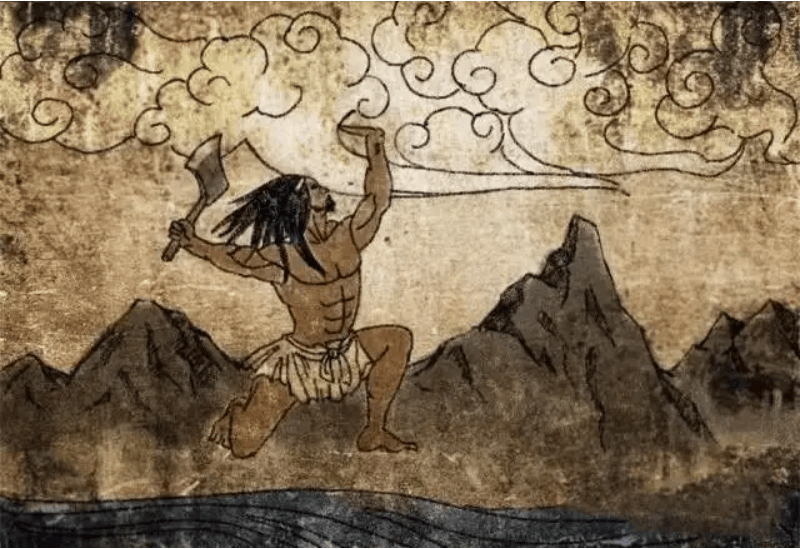
Chen chose three popular myths for this work. In “Pan Gu Creates Heaven and Earth,” a primordial giant breaks out of a dark, cosmic egg and spends 18,000 years physically separating the sky from the earth. Upon his death from exhaustion, his transformed body parts become the sun, moon, mountains, and rivers. In “Nu Wa Creates Human Beings,” the goddess Nüwa creates humanity from yellow clay because she feels lonely in the vast, newly formed world. To quickly populate the earth, she hand-sculpts the first humans to become the nobility, then uses a vine to splatter mud droplets that transform into the common people. In “Weaving Maid and Cowherd,” a celestial goddess and a mortal cowherd fall deeply in love but are permanently separated by the Goddess of Heaven, who created the Milky Way to keep them apart. Once a year on the seventh day of the seventh lunar month, a sympathetic flock of magpies forms a bridge across the stars so the lovers can briefly reunite.
Joshua Kosman wrote in a review of the premiere in 1996, “The basic elements of those stories could be made out even by an unversed Westerner. . . . The most interesting component was the interplay between the orchestra and the four Chinese instruments—erhu (fiddle), yangqin (dulcimer), pipa (lute) and zheng (zither)—that feature prominently as soloists. . . . [Chanticleer’s] finest moment came at the end, with a darkly radiant a capella hymn as the Weaving Maid and the Cowherd find a celestial bridge for their love.”
My classical music post for today is Chen Yi: Chinese Myths Cantata.


Leave a Reply