

Throughout history, myths and legends have brought ancient mysteries and epic sagas to life. This September, the Daily Classical Music Post will explore how composers from different eras and continents have reimagined these stories through the universal language of music.
I have been fascinated by the story of King Arthur, Excalibur, the Knights of the Round Table, and Camelot since I was a young child. Some of the legends have focused on the famous love triangle, revealing how human emotion can destroy a utopian society; others have brought the chivalry and heroism of the knights to the fore; and still others have revelled in the magical aspects through the character of Merlin.
The 12th-century writer Geoffrey of Monmouth took some ancient Welsh poems about the Arthurian myth and added his own made-up stories, which he published in his Historia Regum Britanniae (c. 1136). One of the most fanciful of these inventions was the story of Arthur’s conception and birth, which Geoffrey claims took place in Cornwall, in Tintagel Castle. In Geoffrey’s story, Tintagel belonged to Gorlois, Duke of Cornwall. King Uther Pendragon lusted after Gorlois’s wife, Igraine; Merlin used magic to disguise Uther as the duke, allowing him to sleep with Igraine, conceiving Arthur. This totally fictitious tale allowed Geoffrey to make up a lot more of the legend, adding almost all of the tragic elements that other writers eagerly took up in their own accounts.
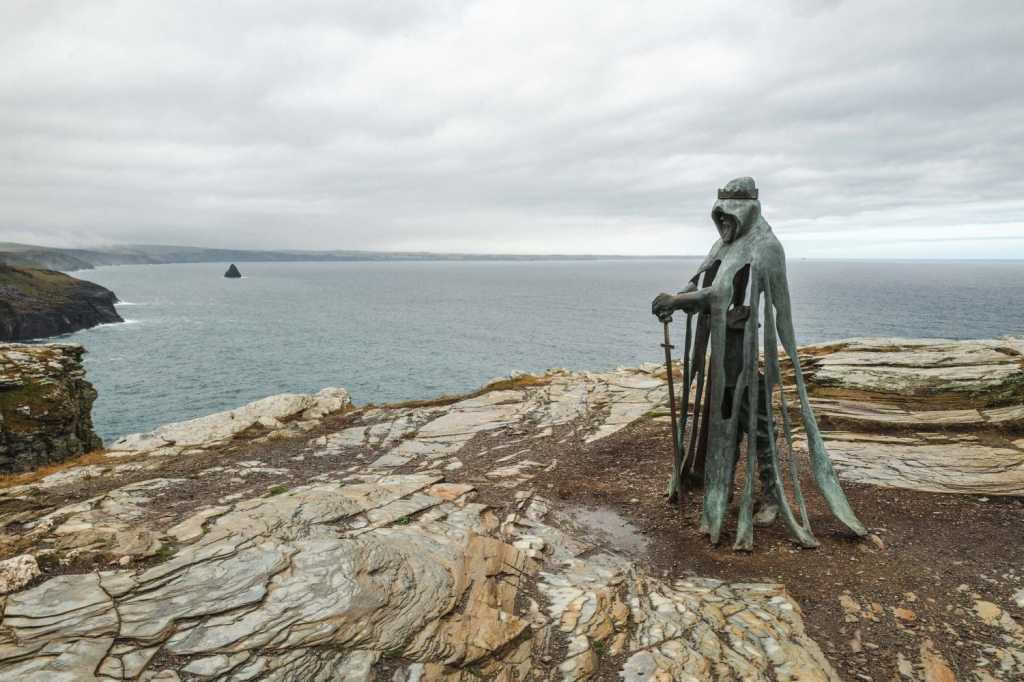
Tintagel was a real place, however, whether or not Arthur was born there, and people bought into the myth. In the 1230s, Richard, Earl of Cornwall, built a castle there because he grew up loving the Arthurian legends and he wanted to connect himself to the mythical king. The ruins are visited by hundreds of thousands of visitors every year, some perhaps hoping to get a sense of the “Once and Future King.”
The English neo-Romantic composer Arnold Bax (1883–1953) wrote his most popular orchestral work, the symphonic poem Tintagel, between 1917 and 1919. Bax wrote that the opening music represents the ruins, and then “[a]fter a while a more restless mood begins to assert itself as though the sea were rising, bringing with a new sense of stress thoughts of many passionate and tragic incidents in the tales of King Arthur and King Mark and others among the men and women of their time.” This wonderfully romantic work is, as one critic put it, “the most vivid sea music ever written.” In the second section of this one-movement piece, Bax quotes from Richard Wagner’s opera Tristan und Isolde; that tragic Celtic tale of forbidden love became part of the Arthurian myth in the 13th century. Bax dedicated Tintagel to his long-time mistress, the pianist Harriet Cohen, and it is thought that his secret love affair was the inspiration for the work; Bax and Cohen visited Tintagel in 1917 after Cohen sent Bax a postcard of the castle with “Lancelot and Guinevere spent many a day on these grassy slopes” written on it.
My classical music post for today is Arnold Bax: Tintagel.


Leave a Reply