

June is the sixth month in the Gregorian calendar, which is the calendar most in use throughout the world. This June, the Daily Classical Music Post explored chamber music, choral music, and operatic sextets from the Renaissance to the 21st century.
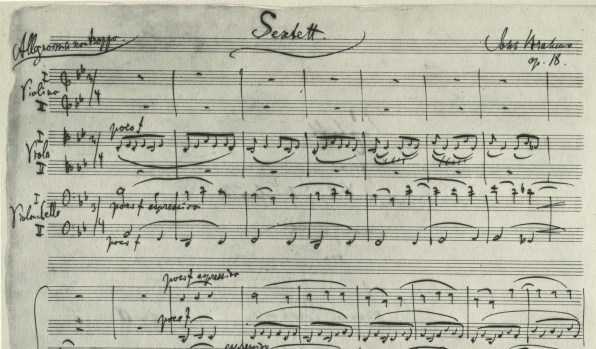
Brahms: String Sextet No. 1 in B-flat Major, Op. 18 (reference recording: Berlin Philharmonic Octet)
Earlier this month we looked at the pioneering string sextets by Luigi Boccherini, composed in 1776. Although a few 19th-century composers wrote works for string sextet, notably Louis Spohr and Aloys Schmitt, no one seemed interested in the format until the German Romantic composer Johannes Brahms (1833–1897) wrote his first string sextet in 1860. This early work, the String Sextet No. 1 in B-flat Major, Op. 18, is considered by some scholars to be Brahms’s way of avoiding the shadow of Ludwig van Beethoven and his string quartets, but it also was a way for Brahms to begin to explore the rich and full harmonic sound that he desired in all of his string and orchestral music. He composed a second sextet in 1864, also a beautiful and nuanced work.
Orrin Howard wrote, “Strange as it may seem, Johannes Brahms clearly had a hang up when it came to writing for strings. He certainly did very well by the violin and cello in the B-major Piano Trio when he was barely 20, in 1853, but he found it easier to combine six strings, which he did in two sextets just a few years later, than he did in the Haydn-Mozart-Beethoven-proven string quartet, which he didn’t venture until about 1865, well after the sextets.”
The String Sextet No. 1 is in four movements: I. Allegro ma non troppo; II. Andante, ma moderato; III. Scherzo: Allegro molto; and IV. Rondo: Poco allegretto e grazioso. One particularly interesting thing about Brahms, as can be seen in this sextet, is his use of different time signatures in the same piece. This was highly unusual in the 19th century, and apparently this rhythmic variety was one of the reasons why Arnold Schoenberg greatly admired Brahms.
The first movement, in 3/4 time and sonata form, has several beautiful themes (interestingly, the opening cello theme is basically in 4/4), and Brahms’s signature use of triplets is apparent throughout. The second movement, in 2/4, is a theme and six variations in a minor key, making it sound quite melancholy and incredibly beautiful. Brahms really was a master at writing theme-and-variations works. The third movement, the Scherzo, is in 3/4, with fun syncopations and a surprisingly quick trio section. The Sextet concludes with the Rondo, in 2/4, with reminders of the first movement. In this final movement, Brahms divides the sextet at one point into two trios, and they have a sort of musical duel. All four movements are wonderful, but I think my favourite is the second movement. The Scherzo is a close second, however.
My classical music post for today is Johannes Brahms: String Sextet No. 1 in B-flat Major, Op. 18.


Leave a Reply