

June is the sixth month in the Gregorian calendar, which is the calendar most in use throughout the world. This June, the Daily Classical Music Post will explore chamber music, choral music, and operatic sextets from the Renaissance to the 21st century.
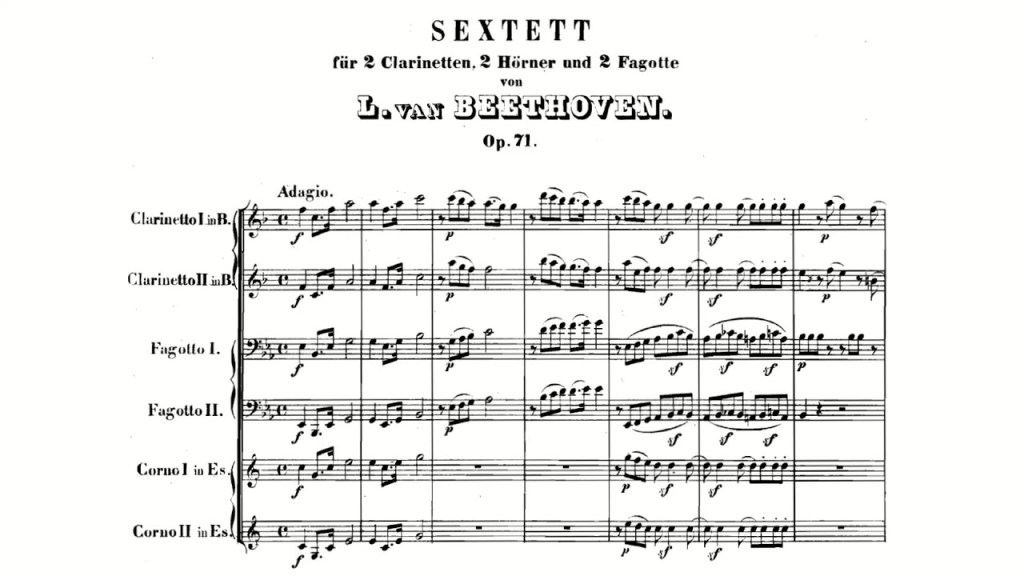
Beethoven: Sextet in E-Flat Major, Op. 71: 1. Adagio – Allegro
Although composers had written music for wind instruments for centuries, it wasn’t until the mid-18th century that wind writing became more sophisticated. This was partly because wind instruments were more refined, as the invention of keys and valves allowed more precise playing and intonation.
The German Classical/Romantic composer Ludwig van Beethoven (1770–1827) began composing for wind instruments when he was in the employ of Maximilian Franz, the Archbishop and Elector of Cologne. Franz believed that wind music helped the digestion and created an ensemble with oboes, clarinets, horns, and bassoons to play while he was eating. (I’m going to try listening to wind music during meals and see if it works!)
In 1796, Beethoven composed his Sextet in E-Flat Major, Op. 71, for two clarinets, two bassoons, and two horns, but it wasn’t performed for nearly 10 years. Strangely, given the number of years that had lapsed from composition to performance, a review of the four-movement work said that it was filled with “a wealth of new and surprising ideas,” but the reviewer also praised the composition “which shines resplendent by reason of its lively melodies [and] unconstrained harmonies.” The Sextet had to wait a further five years before it was published, so although it is an early work, the opus number reflects the date of publication rather than the date of composition.
John Hencken wrote, “The Sextet’s layout reflects the typical classical pattern of four movements, including a minuet, which Beethoven would forego in later works in favor of the more explosive scherzo. The clarinet and the bassoon get most of the ‘lively melodies’ in the Sextet’s opening and closing movements (although the horn has an especially rousing outburst at the end of the first allegro). Beethoven also takes advantage of the different characteristics of the instruments to great effect. Witness, for example, the simplicity of the theme played by the bassoon at the outset of the adagio, and how Beethoven recasts it for clarinet and bassoon in dialogue over a gently rocking accompaniment, as a single theme becomes a conversation between two players.”
My classical music post for today is Ludwig van Beethoven: Sextet in E-Flat Major, Op. 71: 1. Adagio – Allegro.


Leave a Reply