

June is the sixth month in the Gregorian calendar, which is the calendar most in use throughout the world. This June, the Daily Classical Music Post will explore chamber music, choral music, and operatic sextets from the Renaissance to the 21st century.
The Sixth Book of Madrigals: Sestina : Lagrime d`amante al sepolcro dell`amata
The sestina, a fixed verse form made up of six stanzas of six lines each, followed by three lines at the end, originated in 12th-century Provence and quickly spread via troubadours throughout continental Europe. The popularity of the sestina continues to this day.
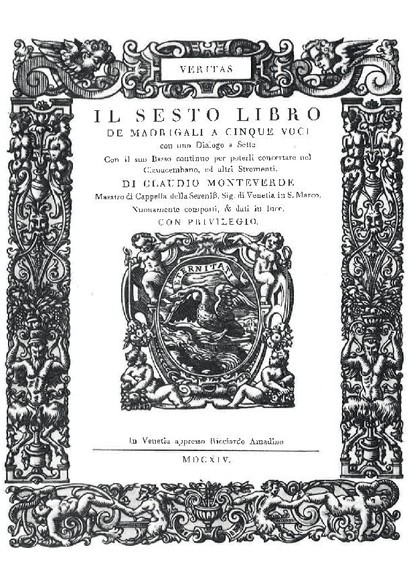
In 1614, the Italian Renaissance/Baroque composer Claudio Monteverdi (1567–1643) published his Sixth Book of Madrigals, not long after he was appointed maestro di cappella of San Marco in Venice. The subject of most of the madrigals in Book 6 is that of loss, in particular the extraordinary Sestina: Lagrime d’amante al sepolcro dell’amata (Tears of a lover at the tomb of his beloved), composed in memory of the young singer Caterina Martinelli. Martinelli had premiered the title role in Monteverdi’s opera L’Arianna (1608) and also had prominent roles in many other early operas, and her future was bright. However, in late spring 1608, she contracted smallpox and died. She was just 18 years old.
The Duke of Mantua, devastated by Martinelli’s death, commissioned Scipione Agnelli to write a sestina dedicated to her, and Monteverdi, who was still employed by the court in Mantua at that time, was asked to set the sestina to music. John Whenham wrote, “Monteverdi was clearly deeply moved by Caterina’s death, and his setting is by turns sombre and agonized. Sometimes the voices chant together, sometimes grate against each other as emotion breaks through. At these points Monteverdi occasionally casts aside Agnelli’s careful word order, as in Part 5, to create the climactic phrase ‘Ohimè! [chi vi] nasconde?’ (‘Alas, who hid you there?’) which quotes the opening music of Arianna’s lament, now hidden in the lament for its intended singer.”
William Cutter and Ahmed E. Ismail wrote, “Throughout the work’s six movements, it is Monteverdi’s astonishing text-painting ability that propels the work forward. Who else could depict the flowing of rivers in a mere two bars in ‘Ditelo, o fiumi,’ or the despair and torment of Glauco’s final cries in the finale? Who else can make heaven sound guilty for stealing the beloved away in the fifth song, after so sweetly asking for the mercy of heaven in the third song? In Monteverdi’s music, the overarching purpose is an immediate and uncanny response to the text; in its present guise, it gives us one of the masterpieces of the seventeenth-century madrigal literature.”
My classical music post for today is Claudio Monteverdi: Sestina: Lagrime d’amante al sepolcro dell’amata.


Leave a Reply