

June is the sixth month in the Gregorian calendar, which is the calendar most in use throughout the world. This June, the Daily Classical Music Post will explore chamber music, choral music, and operatic sextets from the Renaissance to the 21st century.
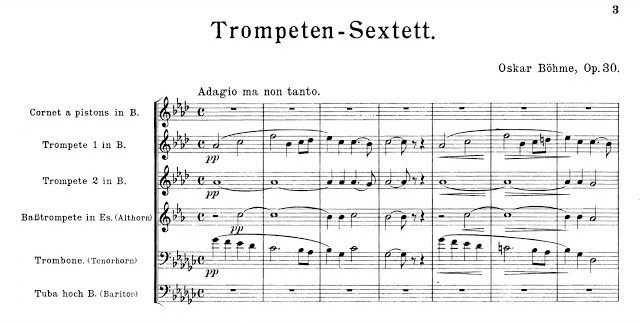
Trompeten-Sextett, Op. 30: I. Adagio ma non tanto. Allegro molto
I could listen to the Trompeten-Sextett in E-flat minor, Op. 30 by the German-Russian Romantic composer Oskar Böhme (1870–1938) every day and never get tired of it. Böhme was a trumpeter, and after studying in Leipzig he moved to Budapest and then to St. Petersburg, where he played cornet in the Mariinsky Theatre and also taught. In 1936, he was arrested under Joseph Stalin’s policy against foreigners performing in music in Soviet Russia, and he was executed by firing squad in 1938.
Böhme composed nearly 50 works, most of which were banned for many years, although the Trompeten-Sextett and his Trumpet Concerto were known and performed outside the Soviet Union. In the late 1970s, however, he was rediscovered, and he was “judicially rehabilitated” in 1989, leading to a renewed interest in his compositions.
Some sources say that the Trompeten-Sextett was composed in 1907, others 1911, but most scholars say that it’s not possible to determine exactly when it was composed. We do know that the original instrumentation was for cornet in B flat, two trumpets in B flat, bass trumpet in E flat (or alto horn), baritone horn in B flat (or trombone), and euphonium in B flat. Modern editions often are arranged for three trumpets (with horn substituting for the third trumpet), trombone or baritone (substituting for the alto horn), trombone or baritone, and tuba.
The first movement, in sonata form, begins with a chorale-like and solemn Adagio. The Allegro contains short sequences and ends with a fanfare. The coda recalls the opening theme from the Adagio over quick countermelodies. The lush sound is partly due to Böhme’s use of high brass, giving the piece a melodic brilliance unusual for brass ensemble music of the time. There are hints of the introduction to Felix Mendelssohn’s oratorio Elijah as well as obvious and distinctive Slavic folk music influences.
My classical music post for today is Oskar Böhme: Trompeten-Sextett in E-flat minor, Op. 30, I. Adagio ma non tanto. Allegro molto.


Leave a Reply