

Classical music collaborations range from joint compositions and artistic partnerships to modern crossover projects bridging genres. Some works, particularly in the 18th century, were intentionally created in sections for different composers to work on. This April on the Daily Classical Music Post, we explored some of these partnerships and learned why collaboration is one of the cornerstones of classical music.
Verdi: Rigoletto, Act III: Bella figlia dell’amore (Quartet)
The Italian composer Giuseppe Verdi (1813–1901) is quite possibly the most famous and beloved Italian opera composer of all time. Verdi and the librettist Francesco Maria Piave (1810–1876), collaborated on 10 operas between 1844 and 1861. Among the masterpieces that they created were Rigoletto, La Traviata, and Macbeth.
Earlier this month, I said that Puccini’s Tosca was one of my favourite operas. The opera that holds the top spot in my heart, however, is Verdi’s Rigoletto (1851). I first heard this opera when I was four years old and immediately wanted to hear it again and again. And I know that I’m not the only one who loves this opera; I have been in small towns throughout Italy and people will spontaneously sing arias from Rigoletto!
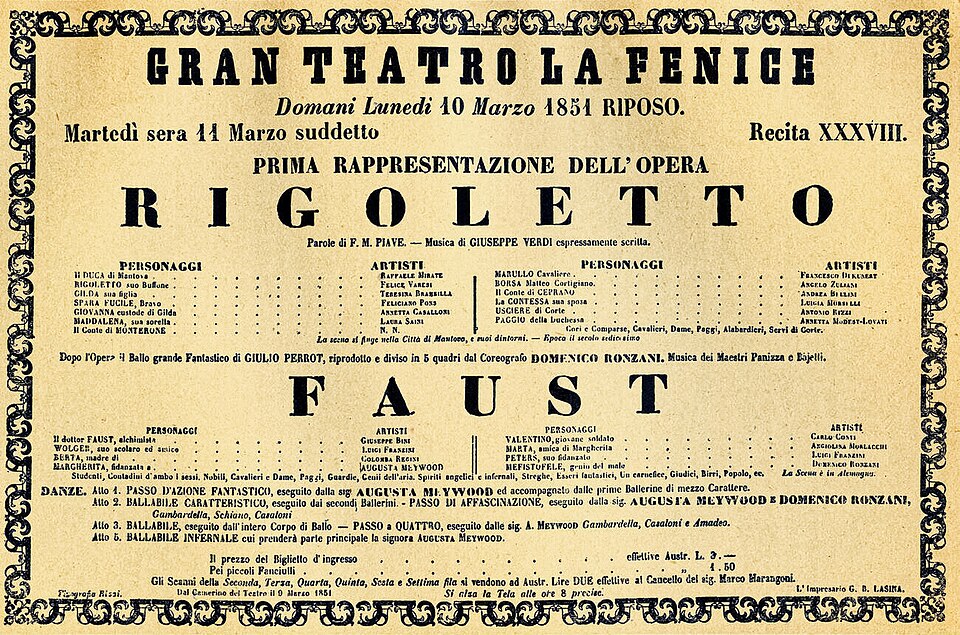
But Rigoletto almost didn’t happen. Julian Budden wrote, “The subject of Victor Hugo’s play Le Roi s’amuse (literally, The King Amuses Himself) first occurred to Verdi in 1849. . . . But it was not all plain sailing. Piave, resident librettist and stage director at the Venice Teatro La Fenice, evidently received assurances by word of mouth (though it is not clear from whom) that the subject would meet with no objection. . . . Barely three weeks before the opening of the opera season, the blow fell. A decree from the military governor forbade the subject absolutely and ‘regretted that the poet Piave and the celebrated Maestro Verdi have not been able to choose some other field in which to exhibit their talents.’ It was not to be resubmitted in any form whatsoever.” Fortunately, however, Piave was able to rework the characters and some of the plot lines enough so the ban was lifted. The premiere in 1851 was a massive success, and it has been a mainstay in opera houses around the world since then.
There are many show-stopping moments in the opera, but perhaps the most incredible of these is the Act 3 quartet, “Bella figlia dell’amore.” The Metropolitan Opera guide to a 2014 staging of Rigoletto said, “In the final act of Rigoletto, Verdi brings together the four leading characters in a masterful quartet that is an intricate musical depiction of four personalities and their overlapping agendas. Each of the four voices in this quartet is exquisitely tuned to its character’s role at this moment in the drama. But the four parts also come to depict a change in those characters’ relationships with one another: the Duke dominates at first but by the end succumbs to Maddalena’s tough-minded critique. Gilda’s part, expressing disillusionment, ends by conveying her inability to even listen to her father’s vengeful plan. She is simply stunned.” The music is beautiful, emotional, heartbreaking, and suspenseful all at the same time, and it is no wonder that it is one of the most celebrated opera quartets in the repertoire.
My classical music post for today is Giuseppe Verdi: Rigoletto: “Bella figlia dell’amore.”


Leave a Reply