

Classical music collaborations range from joint compositions and artistic partnerships to modern crossover projects bridging genres. Some works, particularly in the 18th century, were intentionally created in sections for different composers to work on. This April on the Daily Classical Music Post, we’ll explore some of these partnerships and learn why collaboration is one of the cornerstones of classical music.
Karlheinz Stockhausen – Ensemble (1972) [ORIGINAL LP]
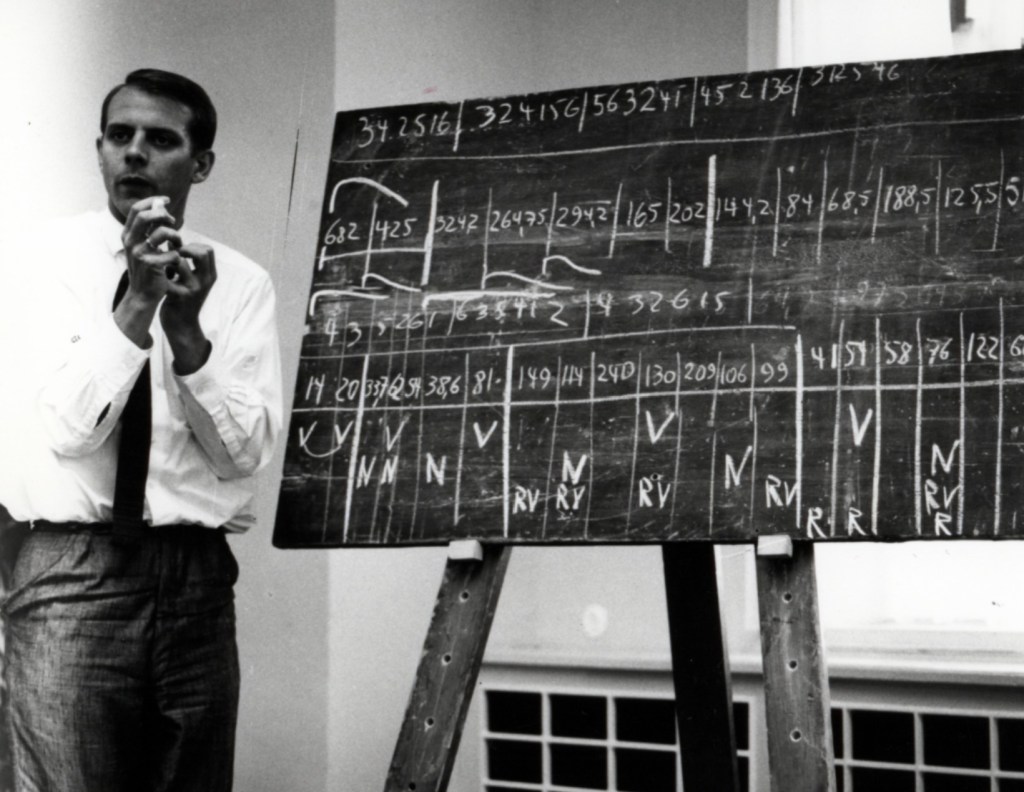
The groundbreaking but also controversial German composer Karlheinz Stockhausen (1928–2007) often collaborated with other musicians to create his music. One of the most fascinating of these collaborations, which he called “collective compositions,” was his group-composition project Ensemble, created for the 1967 Darmstädter Ferienkurse. Stockhausen organized a composition seminar, inviting 12 composers to write a work that would be performed by an instrumentalist and the composer as a dialogue. The instrumentalists were members of the Ensemble Hudba Dneska. Stockhausen planned the performance space and also composed eight inserts, to be used throughout as a way of unifying the other compositions.
The 12 composers came from several different countries: Tomás Marco (Spain); Avo Sõmer (USA); Nicolaus A. Huber (Germany); Róbert Wittinger (Hungary); John McGuire (USA); Peter R. Farmer (USA); Gregory Biss (USA); Jürgen Beuerle (Germany); Mesías Maiguashca (Ecuador); Jorge Peixinho (Portugal); Rolf Gehlhaar (USA); and Johannes Fritsch (Germany). Because Stockhausen was not the only composer, Ensemble was not assigned a number in his catalogue of works.
Clare Lesser wrote, “Ensemble, which Stockhausen describes as ‘a pluralistic, a soloistic and a collective situation all at once’, manifests an early systematic exploration of moving sound, but here, the main performance space is a fixed single unit (a large gymnasium), the audience is mobile, the compositional ‘events’ . . . are superimposed within a strict formal scheme devised by Stockhausen, and the musical events or ‘signals’ (including short-wave radio) are selectively transmitted throughout the performance space via a relay of speakers. Thus, there is an overlapping and bleeding of sound between groups of performers in the physical space, electronically by means of the speaker relay, and acoustically by the mobile audience members, who carry the signals with them.”
Stockhausen organized another collaborative work for the 1968 Darmstädter Ferienkurse, Musik für ein Haus. Fourteen composers and twelve instrumentalists participated in this work. Stockhausen planned to continue this type of collective composition, but his next project, in Bonn, wasn’t successful. He also planned a sequel composition-studio project for the 1970 Darmstädter Ferienkurse, an outdoor event tentatively called Musik im Wald, but this never happened.
My classical music post for today is Karlheinz Stockhausen: Ensemble.


Leave a Reply