

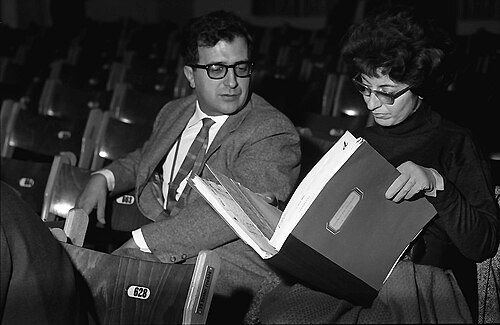
Classical music collaborations range from joint compositions and artistic partnerships to modern crossover projects bridging genres. Some works, particularly in the 18th century, were intentionally created in sections for different composers to work on. This April on the Daily Classical Music Post, we’ll explore some of these partnerships and learn why collaboration is one of the cornerstones of classical music.
Luciano Berio: Sequenza III, per voce femminile (1965)
The collaboration between the Italian composer Luciano Berio (1925–2003) and the American mezzo-soprano Cathy Berberian (1925–1983), who were married from 1950 to 1964, is considered one of the most fruitful and influential partnerships in 20th-century avant-garde music. Their work together revolutionized vocal music, with Berio creating highly innovative pieces that exploited Berberian’s extraordinary vocal range and dramatic talents.
Cedric Feys wrote, “Cathy Berberian and Luciano Berio met at the Milan Conservatory in 1949. The American was looking for a pianist and Berio had a side hustle playing keyboards. This was the beginning of a fruitful artistic collaboration that even survived—they wed in 1950—the end of their marriage. He enabled her to sing in a new way, and without her vocal versatility and virtuosity his work for voice is inconceivable.”
Berio composed Sequenza, a series of 14 works for voice or instrument, from 1958 to 2002. All of the pieces in the series call for extended techniques and were composed with a particular performer in mind. Sequenza III (1965) was inspired by Berberian’s voice and, of course, is dedicated to her. The text, by Markus Kutter, is fragmented, first into words and then into syllables, vowels, and consonants. Some of the vocal techniques called for are labelled “salvoes of laughter” and “tongue-trill against the upper lip.” In addition, expressions are indicated in the score, including “dreamy,” “ecstatic,” and “fading away.” Berio also provided performance instructions, theatrical in nature, including hand and body movements.
This incredibly challenging work is thrilling and occasionally overwhelming to listen to. The technique required is phenomenal. It definitely is an impressive showpiece for a singer with the skill to pull it off.
In a review of a recording of the complete Sequenza series, Raymond Tuttle noted that the performance of the soprano who sang Sequenza III was remarkably close to Berberian’s recording: “It’s gratifying to hear how close Tony Arnold comes to Cathy Berberian in Sequenza III, a fantasia of whoops, yips, and mutterings based on a brief text by Markus Kutter. (I always half-suspected that Cathy was just making it up as she went along, but now I know better!).”
My classical music post for today is Luciano Berio: Sequenza III.


Leave a Reply