

Classical music collaborations range from joint compositions and artistic partnerships to modern crossover projects bridging genres. Some works, particularly in the 18th century, were intentionally created in sections for different composers to work on. This April on the Daily Classical Music Post, we’ll explore some of these partnerships and learn why collaboration is one of the cornerstones of classical music.
R. Schumann, J. Brahms, A. Dietrich – F-A-E Sonata [With score]
The German composers Albert Dietrich (1829–1908), Robert Schumann (1810–1856), and Johannes Brahms (1833–1897) all wanted to compose a violin sonata for their mutual friend the Hungarian violinist Joseph Joachim (whom we met earlier this month), and Schumann came up with a brilliant idea: Dietrich and Brahms should collaborate with him on the sonata. So, in 1853, they set out to write what became the F-A-E Sonata.
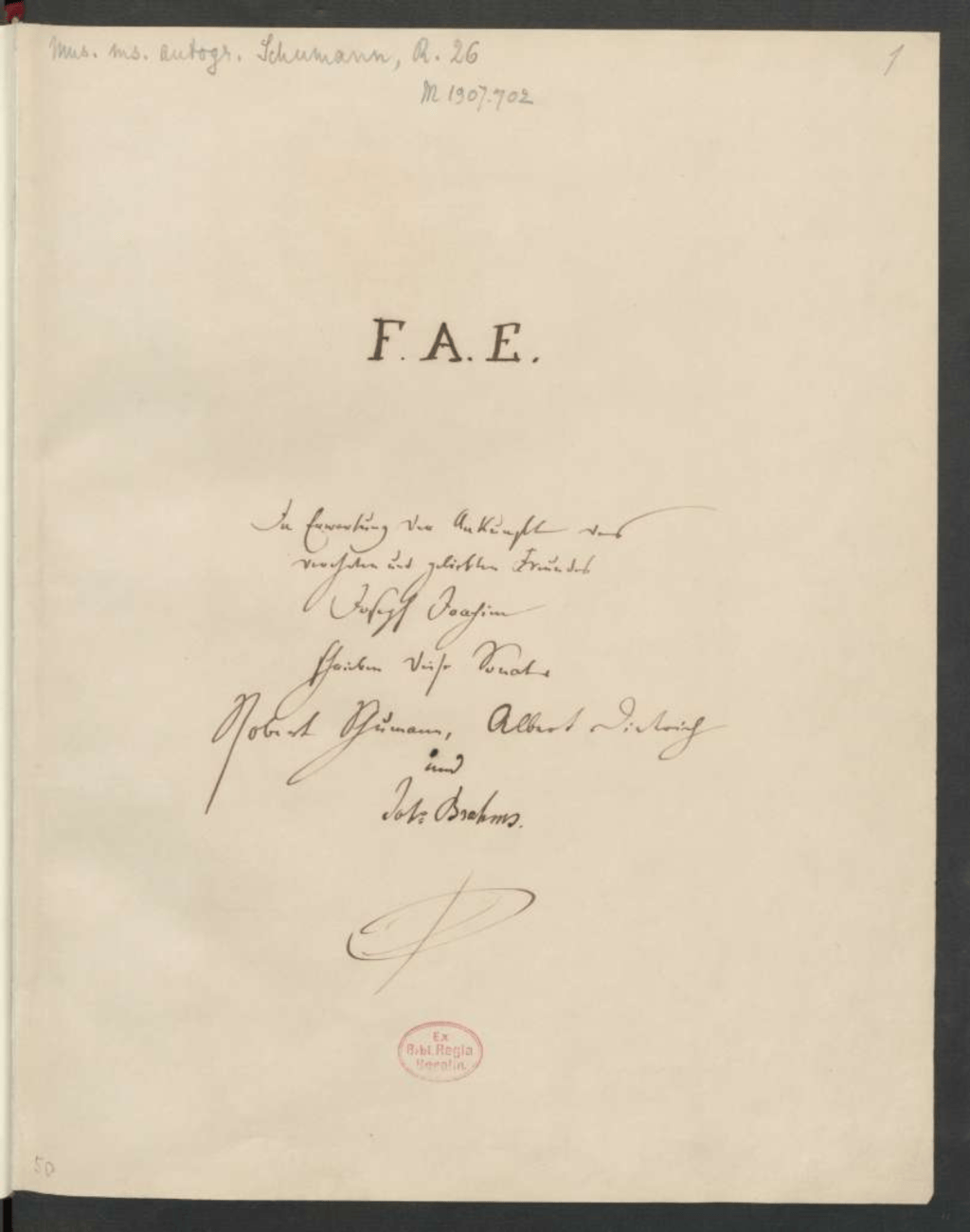
Michael Struck wrote, “Reference is made in the sonata to Joseph Joachim’s private motto ‘Frei Aber Einsam [Free, but lonely]’ by embedding the tone sequence f-a-e. The three composers’ autograph manuscript bears the dedication title: ‘F. A. E. Robert Schumann, Albert Dietrich and Johs Brahms wrote this sonata in anticipation of the arrival of their revered and beloved friend Joseph Joachim’.”
The surprise present for Joachim was presented to him in October 1853 at the Schumanns’ home. The three composers had worked very quickly, in secret, on the four movements, with the older Schumann mentoring his student Dietrich as well as Brahms. Dietrich’s sonata-form Allegro in A minor sets the dramatic mood. Schumann’s Intermezzo (Andante con moto) in A minor is brief but typically complex. Brahms’s Scherzo (Allegro) is in C minor; this energetic movement, his first published work, shows signs of the brilliant orchestrator and symphonist he would become. The last movement, Schumann’s Finale, is a rondo in A minor (marked Lebhaft); references to the earlier movements serve to unify the work. Joachim played the piece as soon as he received it, and he was challenged to identify the composer of each movement (he apparently did so with ease).
Joachim performed the F-A-E Sonata privately many times. Those who heard it were full of praise for its collaborative structure and the cohesive development of the f-a-e motif that held the movements together. It wasn’t published until 1935, although Brahms’s movement was published by the German Brahms Society in 1906.
Schumann later used his two movements in his Violin Sonata No. 3, to which he added two more movements. Although this sonata was performed privately in 1854, it wasn’t published until the 1950s.
My classical music post for today is Albert Dietrich, Robert Schumann, and Johannes Brahms: F-A-E Sonata.


Leave a Reply