

“Give me your tired, your poor, / Your huddled masses yearning to breathe free.” This poem, which once epitomized the spirit of the United States of America, would appear to no longer be true, with immigrant visa processing for more than 75 countries shut down indefinitely by the current US government. This month, the Daily Classical Music Post will explore and celebrate the traditional and contemporary classical music of 31 of these countries.
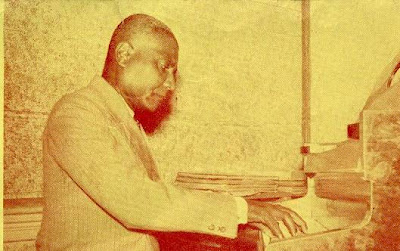
Ludovic Lamothe playing Nibo at home
Classical music in Haiti is a deeply rooted, centuries-old tradition that emerged from French colonial influence. Lauren Eldridge Stewart wrote, “Classical music is a fascinating genre to study in the Haitian context, because there’s a long tradition of the music there. In fact, as long as there’s been a Haiti, there’s been Haitian classical music. . . . As the most lucrative French colony, musicians were trained there, renowned composers were traveling through, and physical spaces were constructed to house the music. . . . Haitian composers also have a way of weaving contemporary genres and folklore into classical music, such that the genre is also a historical tool.”
The Haitian composer and virtuoso pianist Ludovic Lamothe (1882–1953) is one of the most important composers in Haitian music history. He grew up in a family of musicians; he first studied in Haiti and then, when his extraordinary talent was obvious, at the Paris Conservatoire. He returned to Haiti in 1911 and performed and taught music there until his death. He wrote exclusively for the piano. He was influenced not only by Western European classical music but also by local Haitian folk and Vodou ceremonial songs. Edna Taft wrote that Lamothe’s music was “predominantly classical in form, but creole in inspiration.” Many people believe that his fusion of styles reduced class polarization early to mid-20-century Haiti.
In 1936, the American ethnomusicologist Alan Lomax visited Lamothe in Haiti and recorded him playing two of his pieces, including Nibo (composed in 1934). This wonderful recording is available on the Lomax Digital Archive website. A description of the piece on http://chevalierdesaintgeorges.homestead.com/lamothe.html says, “By aligning themselves with the anti-occupation sentiments of the Carnival crowds in song, Haitian elites could participate in political resistance against the occupation by performing méringues de Carnival or Carnival méringues in the privacy of their private piano parlors. Perhaps the best example of this was Lamothe’s ‘Nibo,’ which won the 1934 Port-au-Prince city council competition for the best Carnival méringue. . . . While the musical structure of ‘Nibo’ is unremarkable, its social and political meanings for Haitian audiences are noteworthy. The occupation of Haiti by U.S. Military forces was scheduled to end on 21 August 1934, approximately six months after the 1934 carnival. In this context, ‘Nibo’ was understood as an anticipatory anthem for the celebration to come in August 1934.”
My classical music post for today is Ludovic Lamothe: Nibo.


Leave a Reply