

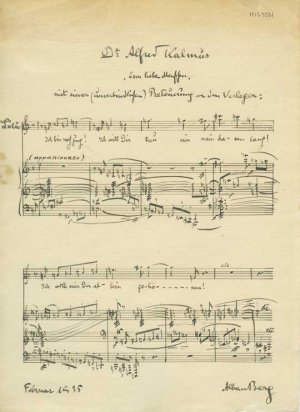
Composers leave works unfinished for many different reasons including untimely death, loss of inspiration, perfectionism, and, in some cases, a feeling that the work is already complete despite being technically incomplete. This February, the Daily Classical Music Post will explore unfinished works and find out the ways in which they are performed today, either still incomplete or finished by other composers.
The Austrian composer Alban Berg (1885–1935) is considered to be one of the most important classical music composers of the 20th century, although his output was relatively small. His music explored human emotions, combining late Romanticism within Arnold Schoenberg’s twelve-tone structure, and he also endeavoured to preserve Viennese musical traditions in his compositions. Although his music was labelled “degenerate” and banned by the Nazis in the 1930s, by the end of the 20th century he was rediscovered and celebrated as one of the most forward-looking of all composers of the Second Viennese School.
Berg’s first opera, the succès de scandale three-act Wozzeck (1922), was the crucial foundational precursor to his second opera, Lulu (1934), which was unfinished at the time of his death. Berg adapted his libretto for the planned three-act opera composed using the twelve-tone technique from Frank Wedekind’s two Lulu plays, Erdgeist (Earth Spirit) and Die Büchse der Pandora (Pandora’s Box). The premiere of the incomplete two-act opera was given in 1937. Berg’s widow Helene asked Schoenberg to orchestrate the sketched-out third act but he declined, saying it was too cumbersome. Helene refused to allow anyone else to touch it, so the opera continued to be performed as a “torso” (the term for a fragmented or incomplete operatic work, often reconstructed from surviving fragments, or a production that only presents portions of a larger piece). However, in 1976, following Helene’s death, the Austrian composer Friedrich Certha completed the third act, and the “finished” opera was first performed in 1979.
Berg created a unique sound world combining his lyricism with powerful orchestral writing. The opera is a gritty exploration of sexual desire, following the downfall of Lulu, an enigmatic and mysterious character who shatters the lives of her many lovers as well as her own. In true twelve-tone style, the score is palendromic. The music has no real melodies or tunes, and it is very difficult for listeners to grasp hold of anything. However, there is something about the opera that makes it compelling and leaves audiences wanting more. Lulu is a masterpiece, recognized as one of the most important, complex, and beautiful gems of 20th-century opera.
My classical music post for today is Alban Berg: Lulu.


Leave a Reply