

Composers leave works unfinished for many different reasons including untimely death, loss of inspiration, perfectionism, and, in some cases, a feeling that the work is already complete despite being technically incomplete. This February, the Daily Classical Music Post will explore unfinished works and find out the ways in which they are performed today, either still incomplete or finished by other composers.
I am a massive fan of the French composer Lili Boulanger (1893–1918); regular readers of the Daily Classical Music Post will recall that I have featured music by this astonishingly talented musician who died so young. Lili left many incomplete works; as she lay on her deathbed, her sister Nadia helped to complete a few pieces, but there wasn’t time to work on everything.
I tried to find a recording of a snippet of Boulanger’s unfinished opera La princesse Maleine (authorized by Maurice Maeterlinck, who wrote the play on which the libretto was based), but although reportedly at the very least a short score of act 1, scene 2 remains, I was unable to find a performance. I also couldn’t find a recording of what was left of her violin sonata or many choral works.
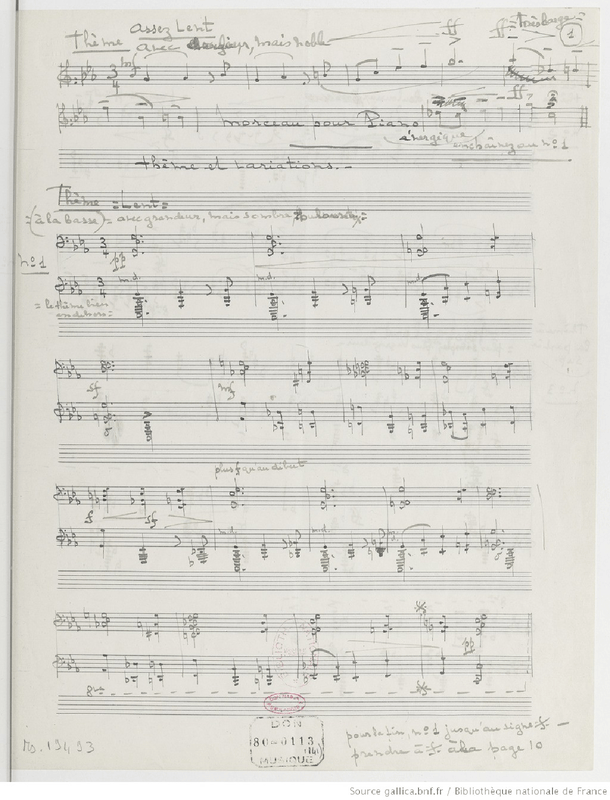
There is some dispute as to whether or not Lili completed the Theme and Variations for piano, which she began composing in 1914 (although sketches exist from 1911); some scholars believe that it was unfinished at her death, and Nadia prepared it for publication, although it was not actually published until 1993.
Pauline Lambert wrote, “The Theme and Variations certainly comes from a typically academic exercise, but we hear all the depth and power of Lili Boulanger’s writing, far removed from the conventional image of a fragile and sickly young girl. It is a dark and mysterious page that grabs you by the gut and does not let go. The theme is a very simple melody that tries to rise, sinuous and tormented, a character that the variations will only accentuate.”
Yu Qian wrote, “Harmonic color is one of the most distinguishing characteristics of Lili Boulanger’s music. . . . Boulanger uses many enharmonic notes to create modal mixture, which increases the tonal ambiguity. She also uses roots as ornamentations and an abundance of parallel motions to avoid the harmonic stability. The Variations also express a sense of bitterness, heaviness, and darkness through Boulanger’s use of chromaticism.”
My classical music post for today is Lili Boulanger: Theme and Variations.


Leave a Reply