

Composers leave works unfinished for many different reasons including untimely death, loss of inspiration, perfectionism, and, in some cases, a feeling that the work is already complete despite being technically incomplete. This February, the Daily Classical Music Post will explore unfinished works and find out the ways in which they are performed today, either still incomplete or finished by other composers.
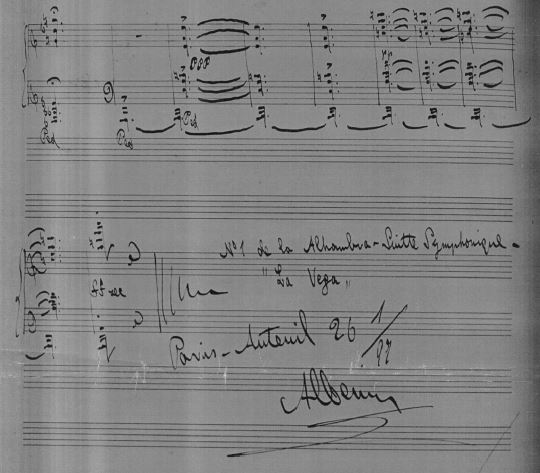
The Spanish virtuosic pianist and composer Isaac Albéniz (1860–1909) began work on a symphonic suite in 1896 when he was living and working in Paris. The suite, tentatively called Alhambra after the Arab palace in Granada, was meant to have six movements, according to the sketches. However, Albéniz only completed La Vega, the second planned movement, and the first 16 bars of Generalife, the planned fourth movement.
Albéniz wrote the score of La Vega as a piano solo format, orchestrating it a year or so later. He never published the orchestral version, but he did revise the piano solo version. He completed this in 1897 and it was published in the same year.
There are several reasons why Albéniz didn’t complete the Alhambra Suite. The main reason was that his style was evolving: his earlier works were in a lighter style, but in 1897 he was already moving towards a more impressionistic approach. His focus turned to his monumental suite, Iberia (1905–1909), which he regarded as his ultimate legacy. His health also affected his ability to work, and he left many projects unfinished at the time of his death at the age of 48.
Norbert Gertsch wrote, “La Vega is inspired by a poem by the English lawyer and poet F. B. Money-Coutts (1852–1923), who, thanks to inherited wealth, was able to free Albéniz from all financial worries for a long time. The composer set Money-Coutts’s poem to music, and at first La Vega was also probably supposed to become a lied before Albéniz decided to make it the introductory piece in The Alhambra Suite.”
Walter Aaron Clark wrote, “La vega presents two distinctive themes: the opening section is loosely based on the Andalusian petenera and exudes a brooding melancholy. The middle section, however, is more buoyant and evokes the jota, a dance native to Aragon in the north of Spain. Albéniz wrote of La vega to a friend that ‘What I have composed is the entire plain of Granada, contemplated from the Alhambra’.”
La Vega is evocative and meditative. It’s no wonder that Claude Debussy, on hearing Albéniz perform the piece, said that it made him want to visit Granada and the Alhambra. The dreamlike, mysterious atmosphere of La Vega is a great example of late Romantic music incorporating early-20th-century Impressionism.
My classical music post for today is Isaac Albéniz: La Vega.


Leave a Reply