

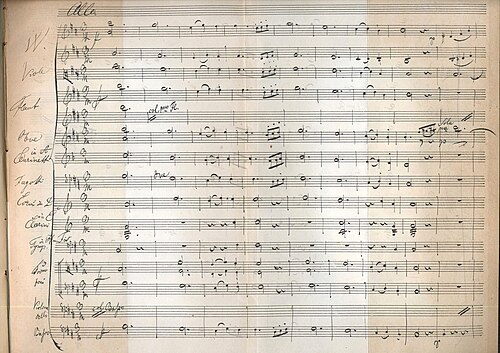
Composers leave works unfinished for many different reasons including untimely death, loss of inspiration, perfectionism, and, in some cases, a feeling that the work is already complete despite being technically incomplete. This February, the Daily Classical Music Post will explore unfinished works and find out the ways in which they are performed today, either still incomplete or finished by other composers.
Schubert: Symphony No. 8 in B Minor, D. 759 “Unfinished”: I. Allegro moderato
One of the most famous unfinished classical works is Symphony No. 8 in B minor, D 759 by the Austrian composer Franz Schubert (1797–1828). It is known usually as the “Unfinished” (Unvollendete) symphony. Schubert began work on it in 1822 in acknowledgement of a Diploma of Honour that he had received from the Styrian Music Society in Graz. However, he only completed two movements, although there also is a two-page partially orchestrated sketch for the third movement. There is some (disputed) evidence that the B-minor entr’acte from his incidental music to Rosamunde is based on what would have been the fourth and final movement.
There are many theories about why the symphony was left unfinished. Some musicologists believe that it was because the completed movements as well as the incomplete third movement were in ternary time, and three consecutive movements in the same basic metre in one classical composition was unheard-of. Other musicologists think Schubert stopped work on the symphony because he got distracted by other compositions. There also is a theory that he had an outbreak of syphilis as he worked on the third movement, and he didn’t want to be reminded of that, so he put the whole piece on hold.
The “Unfinished” symphony is considered to be one of the first Romantic symphonies—perhaps the actual first. Schubert focused on the lyrical content rather than the structure, a hallmark of later Romantic-era works. His orchestration combines instruments, creating timbres that later Romantic composers, for example, Hector Berlioz, would use. I love the beautiful melodies in the opening bars of the first movement; they are memorable and haunting. The use of the trombones, unusual in orchestral works at that time, adds an almost supernatural quality to the piece.
Herbert Glass wrote, “Schubert presented the two completed movements of the symphony to his friend Josef Hüttenbrenner, to be passed on to his brother Anselm. . . . The question remains unanswered to this day: Why did Anselm hold on to the manuscript for nearly four decades after Schubert’s death—by which time the composer, relatively unknown during his lifetime, had become widely appreciated and reports of an ‘unfinished’ symphony in B minor had long been circulating in the press? Adding to the mystery, Anselm made a two-piano arrangement of the symphony that he and Josef Hüttenbrenner performed privately, with Josef assuming that Anselm would publish the original.”
The composer and conductor Johann von Herbeck obtained the manuscript and in 1865 gave the posthumous premiere of the symphony in Vienna. Von Herbeck included the incomplete third movement, although performances today only include the first two movements. The symphony was an immediate success, and it has remained one of Schubert’s most-loved works since then.
My classical music post for today is Franz Schubert: Symphony No. 8 in B minor, D 759, “Unfinished.”


Leave a Reply