

Happy New Year! I’ll be taking a break from writing new posts this month, but never fear, there will still be a Daily Classical Music Post! This January, I’ll be sharing some DCMPs from Januarys in the past. And stay tuned for a whole new theme in February!
First posted January 2016
January 2016 is Celebrate 19th-Century American Composers on the Daily Classical Music Post!
Amy Beach (1867-1944) : Symphony in E minor ‘Gaelic’ Op. 32 (1896)
As Douglas Shadle says in his recent book Orchestrating the Nation, most present-day concertgoers may never hear any of the 100+ symphonies composed by American composers in the 19th century. To most classical music fans, the 19th century is all about the Russians, the Germans, perhaps some other Europeans, but American music of that time is considered to be popular (e.g., Foster). The first American composer most people will have heard of is Ives.
This January, the Daily Classical Music Post aims to correct this. As the music of so many 19th-century American composers is either lost or not performed, it has not been all that easy to find large-scale works. During this month, you will perhaps discover some music that will pique your interest, and perhaps more ensembles will look into performing something other than the usual European standards!
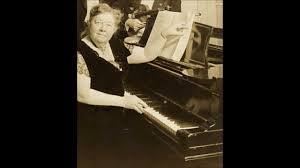
What about the women composers of the 19th century? Well, in 19th-century America, the most well-known and most successful woman composer of large-scale orchestral works was Amy Beach (1867–1944). As a composer, Beach was almost entirely self-taught, although she was an accomplished pianist and singer and had received training in both from a very young age.
Beach’s Symphony in e minor, Op. 32 (also known as the Gaelic Symphony) premiered in Boston in 1896, and was a great success. Adrienne Fried Block says, “Amy Beach, who believed that the older the tunes, the more authentic, found her source for the symphony in a collection published in 1841 by a folk-song collector in Dublin. A lively fiddle tune appears as the closing theme of the first movement, orchestrated to recall the chanter and drone of the bagpipe. The first and second themes, however, are Beach’s own, borrowed from her turbulent sea song, ‘Dark is the Night,’ op.11 no. 1. The monothematic second movement has as its theme a Gaelic love song, first presented as an oboe solo, next by the full woodwind choir, and repeated by strings. For the middle section of this movement, Beach transformed the same love song into a fast, perpetually moving, theme that recalls the scintillating scherzos of Mendelssohn. Two Irish songs, one a paean to Ireland’s natural beauty, the other a lament for a dead child, are the themes of the third movement, the two melodies varied, developed, and combined. Beach wrote that the original themes she composed for the Finale are Irish in style. Their dance-like rhythms, large leaps, and soaring melodies bring this generously-proportioned symphony to an energetic close.”
My classical music post for today is Amy Beach: Symphony in e minor, Op. 32, the Gaelic Symphony.


Leave a Reply