

December is a month for reflection, a time to look back on the past year before looking ahead to the new one. In 2025, there was so much great music to share that I wasn’t able to fit all of it in! So this December, the Daily Classical Music Post has revisited the theme for each month and shared a few of the works that didn’t make the cut.
Bolcom, W The Garden of Eden, IV Through Eden’s Gates
[November 2025: There are two categories of classical music that use visual art as the subject of the composition. “Inspired-by” music takes a work of art as a notional starting point, whereas “ekphrastic” music aims to comment on or illuminate the visual artwork. This November, the Daily Classical Music Post will explore music based on visual art from the Renaissance to the 21st century.]
The name of the great Italian Renaissance painter Masaccio (born Tommaso di Ser Giovanni di Simone), meaning “messy Tom,” is a play on the nickname for Tommaso. Masaccio was one of the most influential Quattrocento artists. His ability to depict human figures was unparalleled at the time, and he was also one of the first painters to use linear perspective in his work.
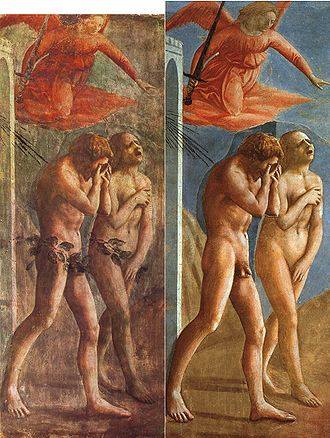
One of my favourite Masaccio frescoes, the Explusion from the Garden of Eden, is from the Brancacci Chapel in Santa Maria del Carmine church, Florence, Italy. The first time that I went to Florence, I kept going back to the church because it was constantly “closed for restoration.” What I didn’t know at the time was that the painting was being cleaned and restored to its original look. Roughly 300 years after Masaccio painted the Explusion, Cosimo III de’ Medici decided that fig leaves had to be added to cover up the nude figures of Adam and Eve. When I studied the work in my Italian Renaissance Art class, all the textbooks showed it with fig leaves. Now, if you go to the church, you will see it as Masaccio intended, sans fig leaves.
The American composer William Bolcom wrote The Garden of Eden in 1969. This suite, in four movements (Old Adam, The Eternal Feminine, The Serpent’s Kiss, and Through Eden’s Gates), tells the story of the Fall in ragtime. Originally written for solo piano, Bolcom later arranged the suite for two pianos. Bolcom said of the fourth movement that it “conjures the magic of Adam and Eve calmly cakewalking their way out of Paradise.”
Richard S. Ginnell wrote, “Bolcom anticipated the revival of ragtime, and Scott Joplin in particular, by about three years. . . . [Joplin’s compositions] inspired him to try his own hand at writing rags. They’re wonderful little pieces that remove the cobwebs of a half century of neglect of the idiom, breathe new life into the formal structures, and then develop or undermine them with injections of advanced harmonies, deeper emotional resonances, and, most delightfully, Bolcom’s own quirky sense of humor.”
My classical music post for today is William Bolcom: The Garden of Eden: “Through Eden’s Gate.”


Leave a Reply