

December is a month for reflection, a time to look back on the past year before looking ahead to the new one. In 2025, there was so much great music to share that I wasn’t able to fit all of it in! So this December, the Daily Classical Music Post will revisit the theme for each month and share a few of the works that didn’t make the cut.31
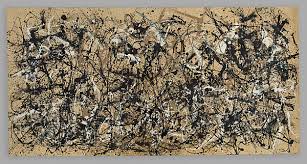
Autumn Rhythm – Camille PEPIN // Mayumi Kanagawa & Guillaume Sigier
[November 2025: There are two categories of classical music that use visual art as the subject of the composition. “Inspired-by” music takes a work of art as a notional starting point, whereas “ekphrastic” music aims to comment on or illuminate the visual artwork. This November, the Daily Classical Music Post will explore music based on visual art from the Renaissance to the 21st century.]
The American artist Jackson Pollock (1912–1956) created Autumn Rhythm (Number 30) in his studio in Springs, New York, working with an unprimed canvas on the ground while he poured and scattered paint on it. Autumn Rhythm (Number 30) is one of the most notable examples of his poured-painting style of the l940s.
The French composer Camille Pépin (b. 1990) merges French impressionism and American minimalism. Her work, Autumn Rhythm, inspired by Pollock’s painting, was commissioned by the Long-Thibaud-Crespin Competition for their Concours Violin in 2018. She said in her programme notes, “In setting aside his brushes and easel, Pollock revolutionised the art of painting with his ‘drippings’. . . . [I]t is the priority given to texture, these superimpositions, the choice of shades, and these tangled bunches of threads that give the painting its insistent and captivating rhythm. I imagined a whirlwind of autumn colours, like a forest with rays of light attempting to pierce through the foliage. This was the inspiration for this work. . . . Violin and piano—inseparable—intermingle in different rhythmical and coloured layers to create various textures. The playing modes that are used (sul tasto, flautando, right and left hand pizzicati, harmonics, piano pedal, etc.) have an important role in these layers of colours, in particular in order to bring out certain melodic motives. From the first measures, the rhythm is unrelenting and functions over an unremittingly repeated ‘loop’. The motion never really stops, it helps give the piece its heady and hypnotic feeling—the sensation of having plunged into the heart of this autumnal whirlwind girded by light.”
Maureen Buja wrote, “Just as Pollock intertwined the threads of paint in his image, Pépin imagines a whirlwind of autumnal colours: black, brown, ochre, and white.”
My classical music post for today is Camille Pépin: Autumn Rhythm.


Leave a Reply