

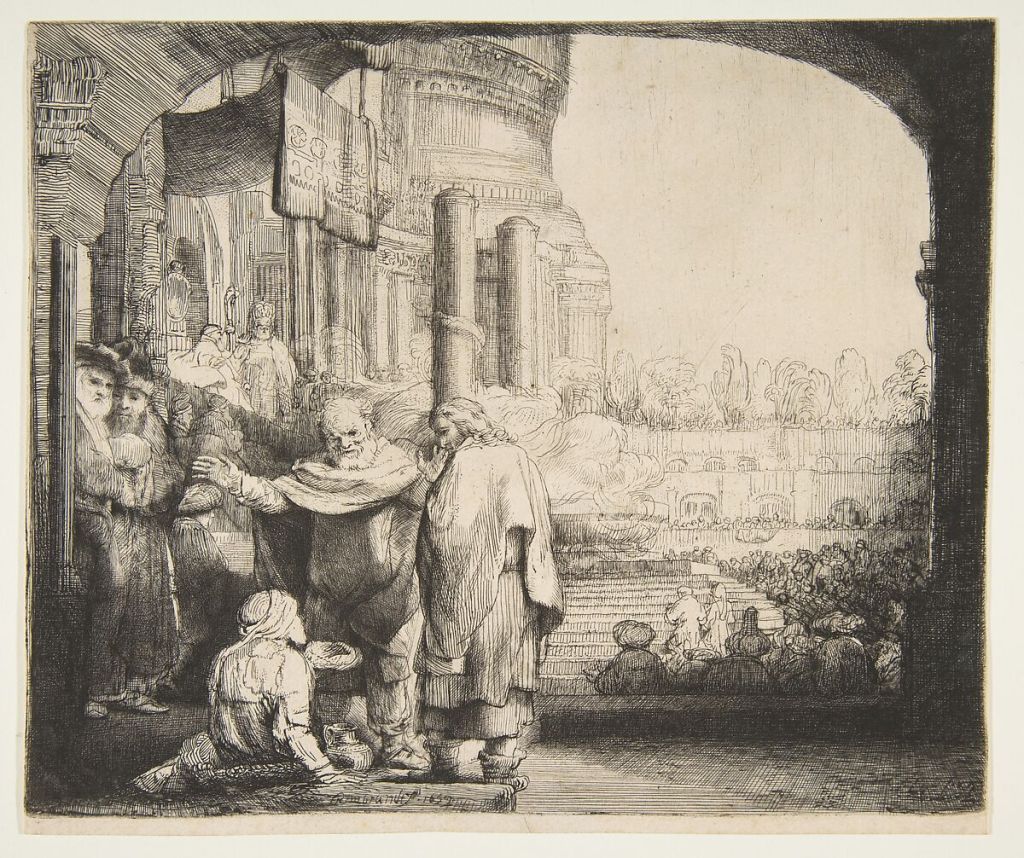
There are two categories of classical music that use visual art as the subject of the composition. “Inspired-by” music takes a work of art as a notional starting point, whereas “ekphrastic” music aims to comment on or illuminate the visual artwork. This November, the Daily Classical Music Post will explore music based on visual art from the Renaissance to the 21st century.
Willem Mengelberg : Rembrandt Etsen (1906)
The Dutch Golden Age artist Rembrandt is considered to be one of the greatest visual artists in the history of Western art. He produced hundreds of paintings, etchings, and drawings, ranging in subject matter from portraits to landscapes and depicting biblical as well as contemporary scenes. He included himself in some of his biblical works, usually as a member of the crowd, and he also created nearly 100 self-portraits. Although his paintings are probably the best known of his output, it is in his black-and-white etchings that his genius in constructing shadow, meticulous mark by meticulous mark, can be seen.
The Dutch composer and conductor Willem Mengelberg (1871–1951) was a great admirer of Gustav Mahler, and the influence of the latter composer can be heard in many of Mengelberg’s works. During World War II, Mengelberg was accused of being a Nazi sympathizer, which led to his being ostracized. A re-examination of his life in the 1980s revealed that he was not what people claimed he was, and his reputation since then has been slowly restored.
Mengelberg was a huge fan of Rembrandt’s art, and one of his most beautiful orchestral compositions, Rembrandt Etsen (1906), was inspired by Rembrandt’s art. The 300th anniversary of Rembrandt’s birth in 1906 was celebrated with parties and exhibitions in several Dutch cities. At one of these events, held at the Stadsschouwburg in Amsterdam, a collection of Rembrandt’s etchings was displayed and accompanied by the premiere of Mengelberg’s Rembrandt Etsen. The 19 movements correspond to 19 etchings, beginning with a self-portrait and continuing with various biblical scenes. Rembrandt Etsen was very well received at its first performance, although it is not often played today.
Laurent Marty wrote, “An admirable conductor, Willem Mengelberg was also a composer, as evidenced by these Etchings of Rembrandt, a passionate and somber homage to the painter. A lover of heady sonorities—those of the Concertgebouw are unique—Mengelberg deploys all the possible resources of orchestration here, sometimes with a touch of grandiosity, without, however, veering into the kitsch of [Leopold] Stokowsky, the undisputed champion of the style.”
My classical music post for today is Willem Mengelberg: Rembrandt Etsen.


Leave a Reply