

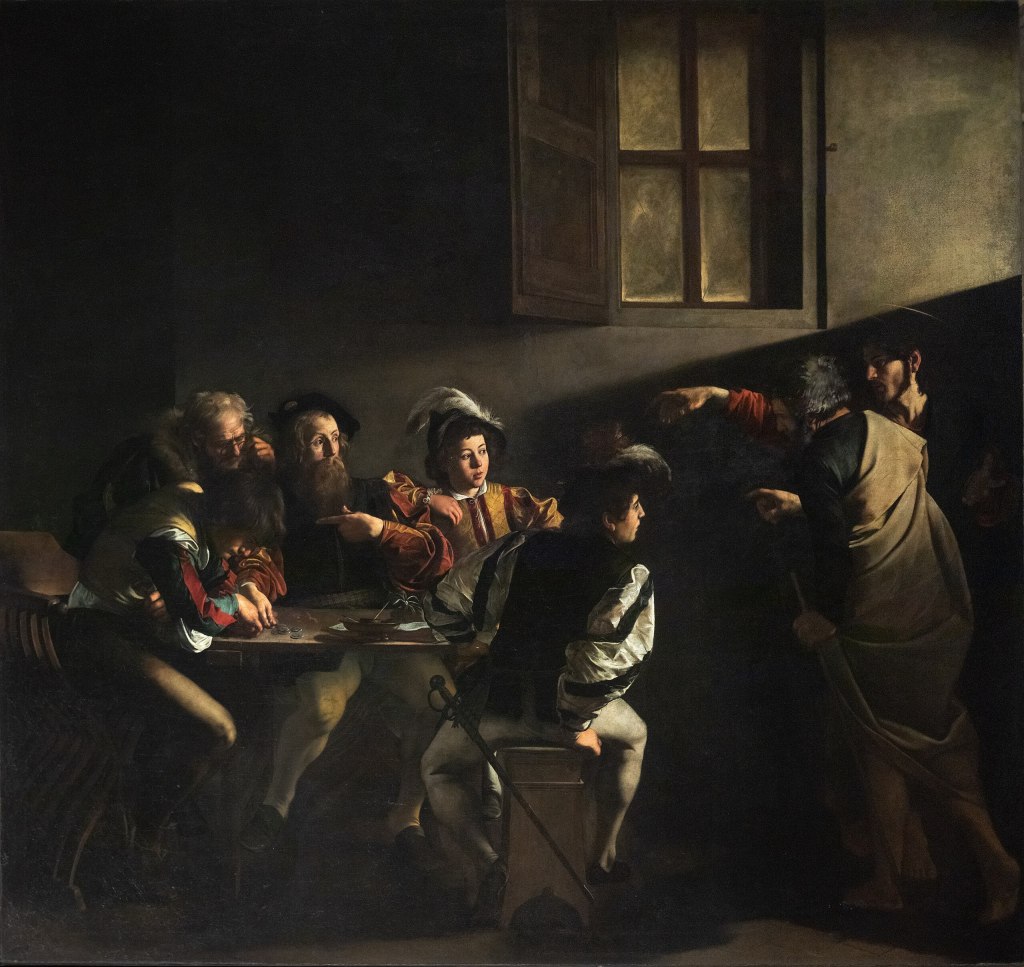
There are two categories of classical music that use visual art as the subject of the composition. “Inspired-by” music takes a work of art as a notional starting point, whereas “ekphrastic” music aims to comment on or illuminate the visual artwork. This November, the Daily Classical Music Post will explore music based on visual art from the Renaissance to the 21st century.
The Italian painter Caravaggio was a major innovator. His dramatic use of chiaroscuro, known as tenebrism, was a primary influence on his contemporaries and led to the new Baroque style that emerged from the prevailing Mannerism of the High Renaissance. He was also a real character: in 1606 he killed a man in a brawl in Rome. In Malta in 1608 he was involved in another brawl, and yet another in Naples in 1609. By the next year, he was dead. Many of his paintings were religious but his subjects were treated in a natural, realistic way rather than the prevailing style of making religious figures “heavenly.” The Calling of St Matthew (1599–1600) is a great example of Caravaggio’s genius. Although this painting has a biblical origin, the figures are dressed in contemporary clothing. The use of light and shadow creates drama and helps to frame the action depicted in the painting.
The Spanish composer and viol player Jordi Savall (born 1941) is one of today’s main figures in the study and performance of Western early music. He has popularized the viola da gamba, and he has composed and performed works in styles ranging from medieval, Renaissance, and Baroque through to the Classical and Romantic periods. In 2006, Savall composed Lachrimae Caravaggio, in seven “stanzas” or statios,” to accompany an exhibition of Caravaggio’s painting in Barcelona. Savall said of Caravaggio, “Everything he did was imbued with light. I owe him so much as a human being and as an artist.”
A review of the recording of Lachrimae Caravaggio on MusicaAntigua.com said, “Inspired by some of Caravaggio’s religious paintings, Jordi Savall created this magnificent album in which he mixes his own compositions with others by Renaissance authors, making it impossible to distinguish when one begins and the other ends. The result is an impressive work, with a clear and light sound that, far from opposing the solemnity and weight of the motif, enhances each other.”
Jeffrey Tucker wrote, “I’m not sure how my paws ended up on this remarkable little treasure, but I’m sure glad I have it. It is Lachrimae Caravaggio, by Jordi Savall. It’s a new release and new music, based on old music, but also something completely unexpected. It is old style Spanish music from the Renaissance, redone and improvised for a contemporary purpose.”
My classical music post for today is Jordi Savall: Lachrimae Caravaggio: Cantus Caravaggio I.


Leave a Reply