

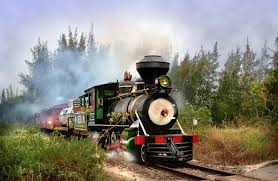
Music is a journey, taking listeners on an emotional and sometimes adventurous sonic path through time to new places both physical and spiritual. Some composers have chosen actual methods of transportation as their theme for this excursion. This October, the Daily Classical Music Post will feature music celebrating methods of transportation, from the land to the sea to the air.
Villa-Lobos ‘Little Train of the Caipira’ – Sir Eugene Goossens conducts the LSO
From 1859 to 1989, trains in Brazil were either steam-powered or horse-drawn. The rail network throughout the country is extensive, at least along and near the coast, but many of the lines were intended to move freight rather than people. Passenger trains in the countryside provide travellers with breathtaking views of waterfalls, viaducts, and tunnels. Narrow-gauge railways connect old mining towns, giving a glimpse into Brazil’s fascinating history.
The Brazilian composer Heitor Villa-Lobos (1887–1959) was described in The New Grove Dictionary of Music and Musicians as “the single most significant creative figure in 20th-century Brazilian art music.” He composed over 2,000 works. He incorporated both Brazilian folk music and European classical style in his compositions, resulting in wonderfully evocative music.
Villa-Lobos travelled by train on some of his adventures collecting folk music throughout Brazil, and he immortalized one of these journeys in the final movement of his orchestral piece Bachianas brasileiras No. 2 (1930), “The Little Train of the Caipira.” He perfectly conveys the sounds and sensations of travelling on a shuddering steam train through the countryside in this beautifully written toccata. Villa-Lobos transcribed this movement for cello and piano, O trenzinho do caipira, soon after completing the orchestral version. He performed the cello part at the premiere.
Michael Fremer wrote, “Villa-Lobos’s folk-oddity ‘The Little Train of the Caipira’ from Bachianas Brasileiras No. 2 is a delightful, evocative piece of music. . . . The music, inspired by a trip the composer took in 1930 on a rural train transporting farm laborers between villages in the Brazilian province of Sao Paolo (the word ‘caipira,’ roughly translated, means ‘yokel’), would have you thinking ‘steam train up a mountain’ even had you not known the composition’s title.” Peter D’Amario wrote, “You hear, almost feel, the train slowly beginning its journey, as the rhythm of the steam release—sometimes syncopated—gathers speed. . . . As the train approaches its destination, the entire orchestra slows down, bit by bit, until the remaining steam is let out and a strong chord ends the trip.”
My classical music post for today is Heitor Villa-Lobos: Bachianas brasileiras No. 2, “The Little Train of the Caipira.”


Leave a Reply