

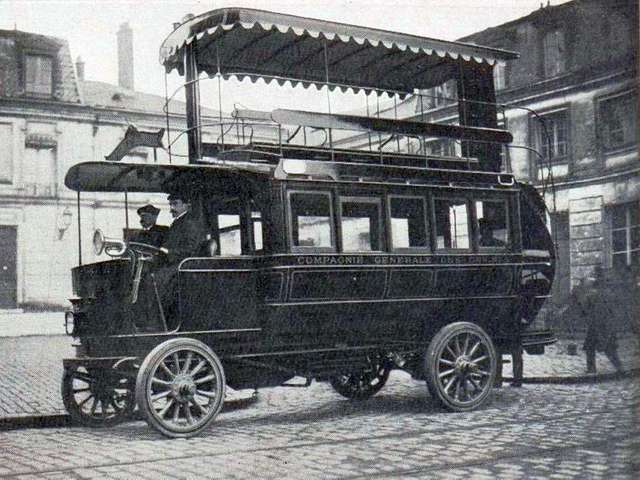
Music is a journey, taking listeners on an emotional and sometimes adventurous sonic path through time to new places both physical and spiritual. Some composers have chosen actual methods of transportation as their theme for this excursion. This October, the Daily Classical Music Post will feature music celebrating methods of transportation, from the land to the sea to the air.
L’Omnibus Automobile (leg. Port.) canção 6/7 | Erik Satie | Bassino | Galien-Laloue
The word “bus” has an interesting history. The original full name was voiture omnibus (“vehicle for all”), coined by a French corn-mill owner who started a horse-drawn mass-transport service in 1923 in Nantes. The name was shortened to “omnibus” and then further shortened to “bus” by the middle of the 20th century. Buses can carry many more people than a car or van but not as many people as a train. But they can go where trains can’t, as they aren’t restricted to travelling on permanent rails. Buses are most often used in public transport, but they also are used by charter and private companies.
The French actor, singer, and writer Vincent Hyspa wrote many fanciful and slightly absurd poems. These poems of course appealed to the French composer Erik Satie (1866–1925), who met Hyspa in 1887 at Le Chat Noir, a cabaret nightclub in the Montmartre district of Paris. Satie arranged and composed the music for approximately 30 of Hyspa’s poems, and he also accompanied Hyspa when he sang in other Parisian cabarets and clubs.
One of Hyspa’s poems, “C’était pendant l’horreur du Quatorze Juillet,” was set by Satie in 1905 as “L’omnibus automobile.” This quite strange poem describes an terrible event that takes place on a hot and steamy 14 July (Bastille Day), when a bus carrying sacks of plaster but no passengers drives through a crowd of people, making them scatter and run away. (“Finally, it stopped at the Place de l’Opéra, / And I saw that it was loaded with bags of plaster. / These bags, said the driver, these bags are there / To replace the cantankerous passengers; / We have been testing them for over twenty months, / And these bags are as important to us as people.”) Hyspa performed “L’omnibus automobile” at the Cabaret des Quat’z’Arts in late 1905.
As with so much of Satie’s output, “L’omnibus automobile” is characterized by its deceptive simplicity, minimalism, and calming, often melancholic, atmosphere. His popular songs like this one appeal to audiences for their accessible melodies and “less is more” aesthetic. His compositions also are notable for their rejection of 19th-century romanticism and virtuosity.
My classical music post for today is Erik Satie: “L’omnibus automobile.”


Leave a Reply