

Music is a journey, taking listeners on an emotional and sometimes adventurous sonic path through time to new places both physical and spiritual. Some composers have chosen actual methods of transportation as their theme for this excursion. This October, the Daily Classical Music Post will feature music celebrating methods of transportation, from the land to the sea to the air.
Anonymous: Codex Calixtinus (Jacobus) Polyphony, plainchant and instrumental collection….
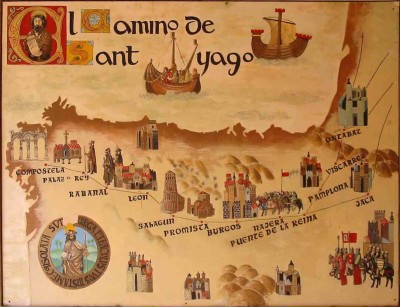
The earliest form of travel was the simplest: walking. Ancient peoples walked to hunt, to explore, and to visit places for spiritual reasons. One example of the latter is the Camino de Santiago, a pilgrimage route developed in the 9th century following the discovery of the tomb of Saint James the Greater. A chapel was built at the site in northwestern Spain, and eventually the Cathedral of Santiago de Compostela took the place of the chapel. By the 12th century, the Camino de Santiago was one of the top three Christian pilgrimage destinations, along with Jerusalem and Rome.
The Codex Calixtinus, a 12th-century illuminated manuscript named for Pope Calixtus II, was written to help guide pilgrims along the Camino de Santiago. The manuscript, which is compiled in five books and two appendixes, includes liturgies, sermons, stories of miracles attributed to Saint James, and other related texts. Book V (now called Book IV) was a sort of early travel guide for pilgrims, as it describes the routes, highlights sites of relics along the way, offers suggestions for where to stop and stay, and contains explanations of local customs. The Codex Calixtinus also includes some of the earliest polyphonic music, which was meant to be sung by the pilgrims as they made their way along the Camino de Santiago.
Marcel Pérès wrote, “The music of the Codex Calixtinus is a compilation of various works originating in important places along the pilgrimage route. It presents a striking picture of the musical styles that were then in use in those parts. The polyphonic pieces in the Codex Calixtinus are very close in style to the Aquitaine and Paris organum repertories, known to us mainly through thirteenth-century sources.”
“Nostra phalanx plaudat leta” (Let our company praise joyfully) does not seem to be associated with any particular liturgy. This hymn has been attributed to Ato, the mid-12th-century Bishop of Trecensis, and was most likely sung to celebrate Saint James. The music is by our old friend Anonymous. The polyphony includes voice crossing and the music is notable for being in the newer style that was being composed in the region at that time.
My classical music post for today is Anonymous: “Nostra phalanx plaudat leta.”


Leave a Reply