

“Everybody talks about the weather, but nobody does anything about it.”—Charles Dudley Warner
Classical music composers may not do anything about the weather, but they often have been inspired by weather and other natural phenomena. This August, the Daily Classical Music Post will explore some of these works and learn about the ways that different combinations of instruments can depict storms, volcanic eruptions, and climate change.
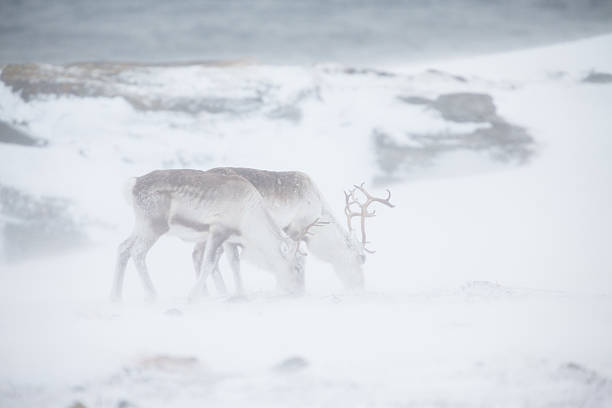
No. 17: With wolves and reindeer in the upland storm
Opplanda, the Uplands, is the ancient name for the lands north of Oslo in Norway. This mountainous inland region is home to diverse wildlife, including reindeer, arctic foxes, wolves, bears, and many other species. They have all adapted to a harsh, cold, wintry landscape, as have the people who live there.
The Norwegian composer Geirr Tveitt (1908–1981) was one of the main figures in the Norwegian cultural national movement in the 1930s. His personal convictions have been connected to far-right German thinking in the 1930s, and this proved devastating to his reputation and led to his ostracism by the Norwegian classical music establishment after World War II. His music has been rediscovered more recently, and in particular people have begun to study his collections and adaptations of traditional Norwegian folk music from the Hardanger district. One collection, Hundrad hardingtonar for orkester (A Hundred Hardanger Tunes), Op. 151, is considered to be among his best work. Some of the pieces have disappeared, and now there are just four suites of 15 songs each extant for a total of 60 songs.
Suite No. 2, which includes tunes 16 to 30, was composed in 1955. No. 17 (also sometimes known as Suite No. 2, No. 2), Med ulvar og rein i uver pao viddæ (With wolves and reindeer in the upload storm), is one of the more well-known pieces from this suite. David Gallagher wrote, “High in the hills a thousand feet above the western shore of the Hardangerfjord lies Bjødnabrakane, where the junipers grow and bears last lived; where, the tale tells, at midnight on Christmas Eve the animals can talk, the snow vanishes and the stream water turns to wine. . . . Bjødnabrakane was Tveitt’s fastness: here he married, had children, immersed himself in Hardanger ways, and ‘tuned in’ to a tradition where music, everyday life, nature and the supernatural are indivisible.” Med ulvar og rein i uver pao viddæ tells the story of a young boy and unrequited love; bereft, he wanders with the wolves and reindeer in an upland storm.
An anonymous Gramophone reviewer wrote, “The Second Suite is largely a pastoral affair, though with moments of rugged grandeur befitting its subject, the mountains of Hardanger in western Norway. They are brilliantly orchestrated, as one now expects from Tveitt.” Jeff Dunn wrote, “His music, in its stark power, speaks to the overwhelming influence of nature on those living among the deep fjords. His technique, superbly developed at the Leipzig Conservatory and subsequent studies in Paris and Vienna, was second to none of his generation of Norwegian composers. The range of expression found in his Hundred Hardanger Folk Tunes suites, and the instantly recognizable originality of his sound, makes him an artist of international significance.”
My classical music post for today is Geirr Tveitt’s Med ulvar og rein i uver pao viddæ.


Leave a Reply