

“Everybody talks about the weather, but nobody does anything about it.”—Charles Dudley Warner
Classical music composers may not do anything about the weather, but they often have been inspired by weather and other natural phenomena. This August, the Daily Classical Music Post will explore some of these works and learn about the ways that different combinations of instruments can depict storms, volcanic eruptions, and climate change.
Krakatoa, Concerto for Viola and Orchestra (Stacy Garrop)
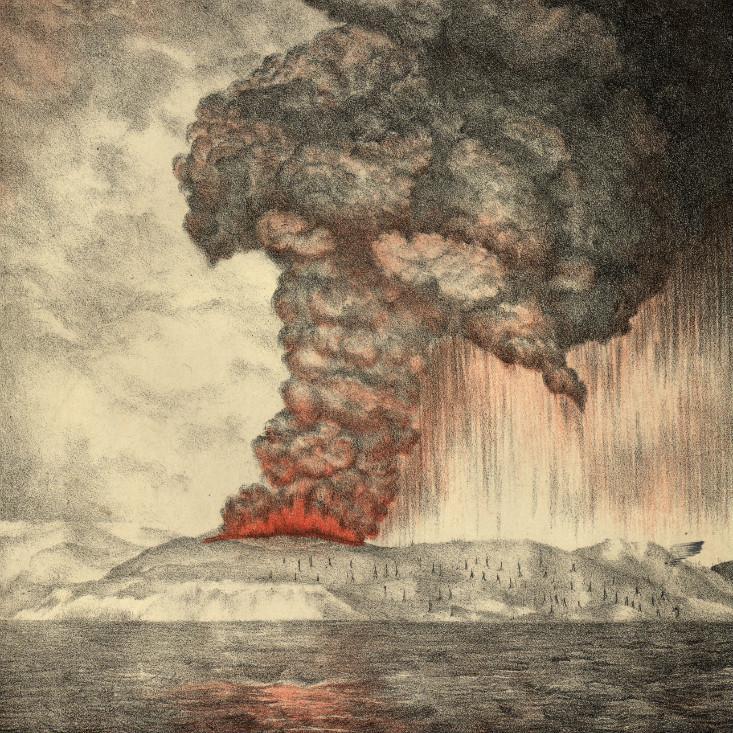
In the September 1884 issue of The Atlantic, E. W. Sturdy wrote, “On the afternoon of the 26th there were violent explosions at Krakatoa, which were heard as far as Batavia. High waves first retreated, and then rolled upon both sides of the strait. During a night of pitchy darkness these horrors continued with increasing violence, augmented at midnight by electrical phenomena on a terrifying scale.”
The eruption of Krakatoa (which actually was west of Java, not east as a 1968 Hollywood disaster film would have us believe) changed weather patterns for several years following the final blast before two-thirds of the island sank below the surface of the sea. Global temperatures worldwide were lowered, and the effects of the enormous amount of ash that was spewed into the atmosphere and the resulting tsunamis changed the Earth irrevocably. An article on the National Centers for Environmental Information website stated, “The final explosion of Krakatau produced the loudest sound ever recorded in modern history, heard across more than 10% of Earth’s surface. Reports of what sounded like distant gunfire were reported from Australia and the island of Mauritius, more than 2,800 miles (4,600 kilometers) from the erupting volcano. Within a few hours, pressure waves traveled several times around the globe. Instruments measured the sudden spikes in Great Britain as well as in America.”
In 2017, the American composer Stacy Garop (born 1969) received a commission from the Barlow Endowment for Music Composition at Brigham Young University. The resulting work was Krakatoa: concerto for alto saxophone or viola, strings, and percussion. Garop wrote in the programme notes, “Krakatoa for solo alto saxophone or solo viola, strings, and percussion follows the path of the volcano’s four main eruptions. In the first movement, Imminent, the violist uneasily plays as the orchestra (representing the volcano) shows ever-increasing signs of awakening. The orchestra bursts forth into the second movement, Eruption, where it proceeds through four eruptions that get progressively more cataclysmic. After the final and most violent eruption, the violist plays a cadenza that eases the volcano into the third movement, Dormant. In this final movement, the volcano slumbers, soothed by musical traits that I borrowed from traditional Javanese gamelan music: a cyclical, repetitive structure in which the largest gong is heard at the end of each cycle, and a musical scale loosely based on the Javanese pelog tuning system. The movement ends peacefully with an array of string harmonics, representing the intense and brilliantly colored sunsets generated by Krakatoa’s ash in the earth’s atmosphere.”
My classical music post for today is Stacy Garop’s Krakatoa: concerto for alto saxophone or viola, strings, and percussion.


Leave a Reply