

Thank you to everyone who subscribes to and supports the Daily Classical Music Post. This July, I will be sharing some favourite posts from the DCMP archives. A new theme will begin in August!
First published 30 September 2013
Today I am sharing music by the highly underrated American composer Charles Ives (1874–1954).
Ives: The Unanswered Question (Live)
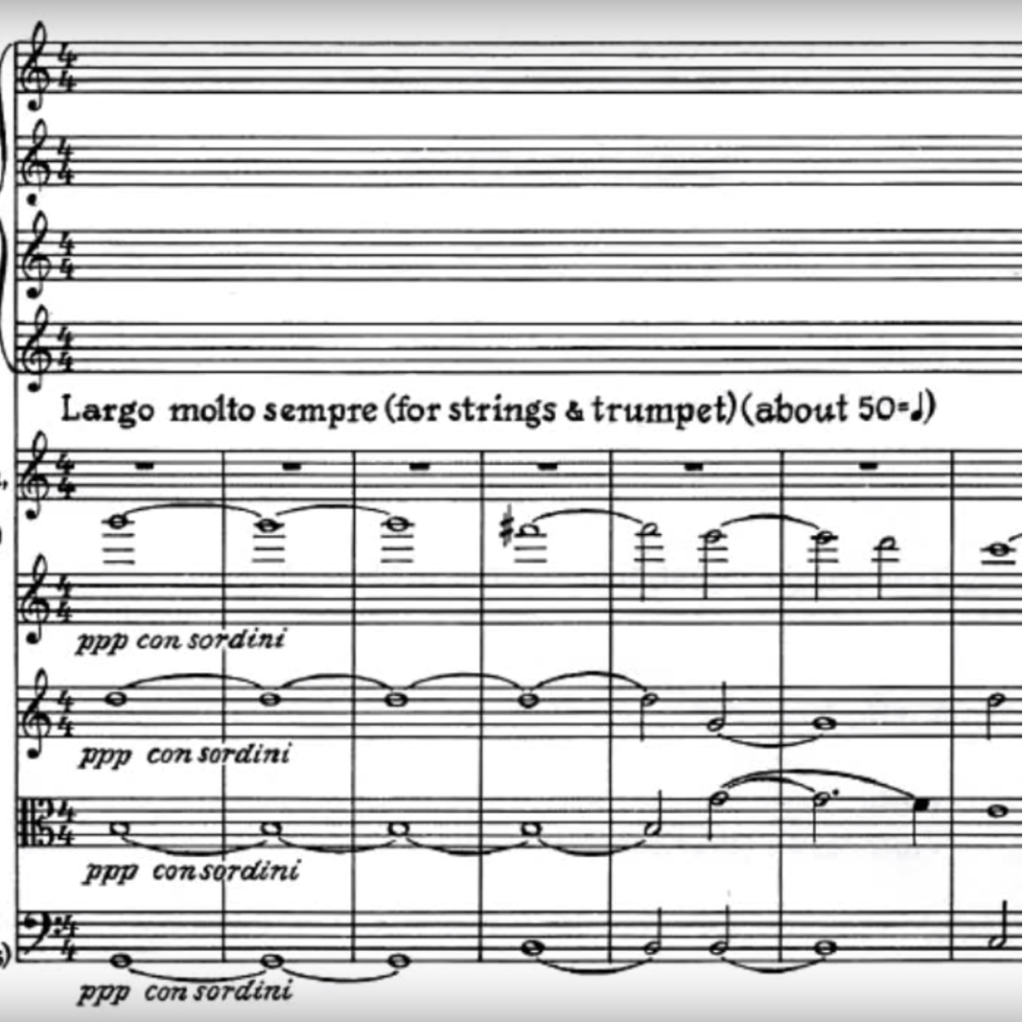
Ives completed work on the original version of The Unanswered Question, for offstage string quartet, woodwind quartet, and solo trumpet, in 1908. The most well-known version is for chamber orchestra, which was premiered in 1946. Strings intone slow diatonic, triadic chords; a solo trumpet asks the question seven times; the flutes try to answer the question, each time getting more and more agitated and nontonal. Leonard Bernstein felt that the woodwinds are said to represent our human answers growing increasingly impatient and desperate, until they lose their meaning entirely. In many ways, The Unanswered Question is an illustration of 20th-century classical music, tonal and nontonal at the same time.
Ives supplied a sort of map for The Unanswered Question: the strings represent “The Silence of the Druids—who Know, See and Hear Nothing.” The trumpet represents “The Perennial Question of Existence.” The woodwinds are the “Fighting Answerers,” who eventually leave “The Question” and allow “The Silences” to be left to their “Undisturbed Solitude.” Some people think that Ives may have been thinking of Emerson’s poem The Sphinx, particularly the line “Thou art the unanswered question,” as he composed this piece. Ives definitely was a fan of Emerson; at Yale, he wrote his senior essay on the poet, and not long after he composed The Unanswered Question, he composed his Emerson Overture.
There is so much uncertainty in the world today, and it is very easy for us to think that things are worse than they ever were. But Ives composed this work over 100 years ago, and obviously things weren’t so easy then, either. Ives definitely understood and appreciated uncertainty; his main career for his entire adult life was that of insurance executive. He was actually more well known in his lifetime for his work in his insurance agency than as a composer. Although as a composer he is considered to be an “American Original,” he was one of the first to combine American and European music, and also incorporated world and experimental styles in his music.
My classical music post for today is Ives’s The Unanswered Question.


Leave a Reply